
Optical harmonic generation is a fundamental process for laser frequency conversion to shorter wavelengths [1]. In recent years, much attention has been paid to harmonic generation in gases because it is a promising method for achieving high intensity, short wavelength coherent light pulses, useful for potential applications in atmospheric pollutants detection through third-harmonic (TH) induced-fluorescence [2] and high-resolution biological imaging [3].
In our experiments TH was generated in atmospheric air by focused femtosecond laser pulses. All experiments were performed using a Ti:sapphire laser system, which generates ultrashort pulses of 100 fs (FWHM) duration with a central wavelength at 800 nm and repetition rate of 1 kHz. Fluorescence images produced by the TH beam on the paper screen, placed in front of the laser beam after the focal plane of focusing lens were registered by the CCD camera. At high laser pulse energies (more than 1 mJ per pulse) a bright blue central spot surrounded by a ring has been observed on the screen (see Fig. 1a). Far-field divergence of the generated TH wave was measured using nine different focal length focusing lenses. It was found that TH ring divergence decreases increasing the lens focal length.
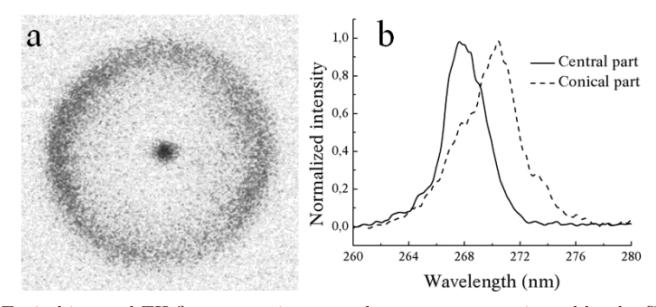
In addition to these measurements the dependence of TH generation efficiency on the focal length L of focusing lens was also registered. It has been found that TH generation efficiency increases with the fundamental pulse energy and is inversely proportional to L. Maximal achieved conversion efficiency to TH signal was about 10-4 for L = 30 cm. Spectral characteristics of TH were measured with a spectrometer “Ocean Optics". During these measurements conical and central parts of TH signal were focused into the fiber delivering light to the spectrometer. It was found that the peak wavelength of conical TH part (about 270 nm) was dependent on the pump intensity and red-shifted in respect with the peak wavelength of the central TH part (Fig. 1b), while the peak wavelength of central TH part was always about 267 nm, which corresponds to the 1/3 of the fundamental wavelength. This red-shift of the TH peak wavelength was explained as a result of the influence of laser-created plasma on the refraction index of air.
In conclusion, the spectral, spatial and energy conversion characteristics of TH generated in atmospheric air by focused femtosecond laser pulses have been investigated. Obtained results indicate that such frequency tripling in air and other gases can be used as an efficient source of coherent UV and VUV light pulses.