Determination of the exact pathways of non-equilibrium carrier recombination in (In,Ga)N remains an open topic despite the intensive studies carried out during the last decade. This interest is strongly based on the non-radiative losses appearing in the light emitting diodes (LEDs) at high carrier densities. The origin of these losses is not established yet; several possible culprits have been named [1]. Main difficulty in disclosing non-linear recombination processes arises from the fact that most studies are being carried on the electrically-driven multilayered LED structures and using time-integrated methods. On the other hand, optical pump-probe methods allow monitoring of excess carrier density in a direct way with good temporal and spectral resolution.
In this work, we present a study of non-equilibrium carrier recombination and diffusion in various (In,Ga)N structures using light-induced transient gratings (LITG) [2], differential transmission (DT) and two-color pump-probe (PP) techniques. We compare carrier dynamics in three MOCVD grown samples: (i) 50-nm thick In0.13Ga0.87N; (ii) MQW structure consisting of 12 periods In0.108Ga0.892N QWs and In0.03Ga0.97N barriers, both of 5.5 nm thickness; (iii) stair-case LED structure consisting of 6-periods of In0.2Ga0.89N/In0.01Ga0.99N QWs having ~3 nm well width. All samples were studied within 80-700 K temperature and ~3x10¹⁸ – 1020 cm-3 carrier density ranges. We recorded the PP and LITG transients for both resonant and non-resonant excitation and were able to estimate accurately the density of photo-excited carriers by precise measurement of laser beam size and energy. This allowed the well-based numerical analysis of the transients using so-called ABC model.
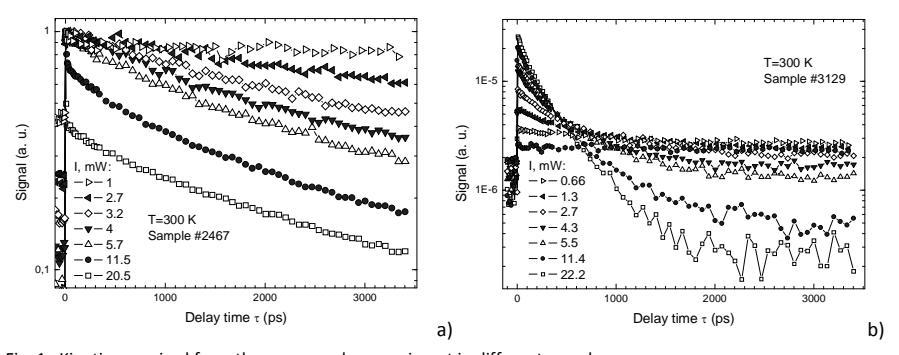
We demonstrate that the density of photo-excited carriers is limited due to stimulated emission (Fig. 1 (a)) and/or absorption bleaching in all the structures, which restrains the possible influence of non-radiative Auger type recombination at room and low temperatures; however, it's influence becomes more feasible at elevated temperatures. Band to band recombination was found to be the main non-linear recombination process at moderate to high carrier densities. On the other hand, the linear recombination term was shown to increase with carrier density, which was attributed to density activated non-radiative recombination. In addition, we demonstrate that structure of an (In,Ga)N plays an important role in carrier recombination.