
Photosynthesis is Nature's most efficient way to obtain energy from distant light sources so it is of high importance to perform research in this field in order to make use of it in energy production. The peripheral light harvesting complex (LH2) which is under investigation is part of purple bacteria Rhodoblastus acidophilus strain 10050, which is capable of producing energy through photosynthesis. The structure of this complex was found using different methods of crystallization [1,2].
The main objective of this work is to compare the properties of spectra, depending on the way the structure of a light harvesting complex was obtained. The structure used in this work was obtained through a crystallization method called in meso [2]. Unfortunately, applying X-ray diffraction on crystallized considerably large molecular complexes some information about the complex is lost and the position of hydrogen atoms is not even found. Therefore crucial data about the electrostatic environment within this photosynthetic complex is gone and has to be modeled additionally.
The spectral properties of photosynthetic complexes are calculated using Frenkel exciton approximation. The properties of this complex are defined through Frenkel exciton Hamiltonian in pigment excitation representation [3]:
$$\widehat{H} = \sum_{m} E_{m} \widehat{B}_{m}^{\dagger} \widehat{B}_{m} + \sum_{m,n \atop m \neq n} V_{mn} \widehat{B}_{m} \widehat{B}_{n}\tag{1}$$Where $E_m$ denotes site energies of the pigments, $V_{mn}$ – excitonic coupling between pigments. Since the photosynthetic complex is ~9000 atoms excluding hydrogen, only approximate methods can be used to evaluate the elements of the Hamiltonian (1). $E_m$ is calculated using CDC method and $V_{mn}$ using TrEsp method [4]. Charge layout for this modeling is adapted from [5], where properties of the same LH2 complex are found based on another structural file[1].
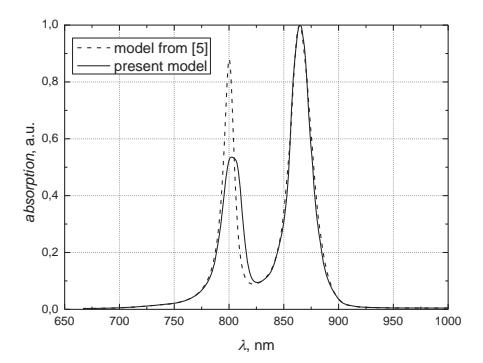
As seen in fig. 1, the exactly same model applied to different structural files gives somewhat different absorption spectra. In this research we look for the reasons of this mismatch investigating the differences in two structural files. In this way we try to clarify the structure-function relationship within photosynthetic pigment protein complexes.