Ever since the discovery of piezoelectric effect, piezoelectric materials have been rapidly developed and widely used. The most widely used piezoelectric materials are $Pb(Zr,Ti)O_3(PZT)$-based ceramics because of their superior piezoelectric properties. However due to legislative enforcements, representatively the European RoHS/WEEE regulations [1], lead-free piezoelectric materials have been extensively studied last decade. Among the studied materials, $(1-x)(Na_{0.5}Bi_{0.5}TiO_3)$-xBa$TiO_3$ ceramic family has been of particular interest because of the similar piezoelectric properties to PZT ceramics [2].
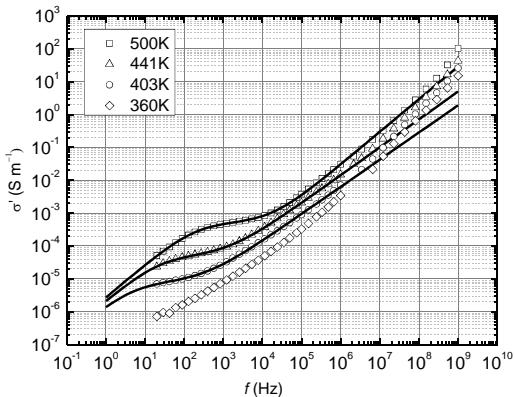
In the present work the dielectric and impedance properties of Fe doped $0.94(Na_{0.5}Bi_{0.5}TiO_3)$-$0.06BaTiO_3$ ceramics in 20Hz-1GHz frequency range and 300-500K temperature range are investigated. The measurements of dielectric permittivity were performed during freezing cycle with 1K/min temperature variation rate. Conductivity was calculated using dielectric permittivity data. Fig. 1 shows frequency dependency of the real part of complex conductivity. Experimental data was fitted with generalized universal Jonscher's law [3]. The best fits were obtained for 403K-500K temperature range. One conductivity process was distinguished with Arrhenius behavior of $\sigma_{DC}$ and possible cause of conductivity process is discussed.