
Application of terahertz (THz) waves for security, medical diagnostic and imaging needs [1] remains the main stimulus to develop compact and sensitive THz detectors which would operate at room temperature. This work is dedicated to theoretical analysis and optimization of InGaAs "bow-tie" diodes [2].
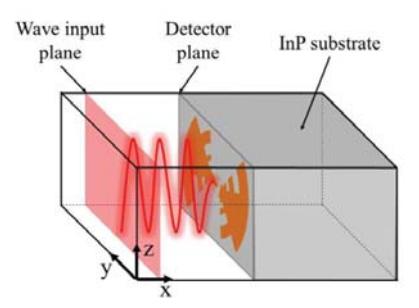
Simulations, using 3D finite-difference time-domain method, [3] were used to calculate a distribution of electromagnetic field amplitude ratio in an active zone of the detector plane. Typical simulation area is shown in Fig. 1. Black cuboid edges show simulation area size. It was considered that planar antennas were made of ideal conductor on InP substrate which dielectric permittivity is $\varepsilon$=12.61. The plane on the left (Fig. 1) shows the entrance of THz frequency wave and the grey cuboid on the right denotes InP substrate. Plane wave propagates along x coordinate direction.
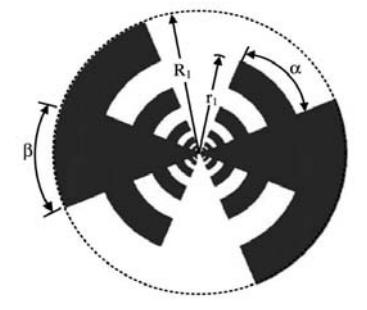
Two types of structures were studied. The first one was log-periodic antenna presented in Fig. 2. It has a log-periodic circular-toothed structure with tooth and bow angles of $\alpha$ and $\beta$. The ratio of the radial sizes of successive teeth is $(R_{n+1}/R_n)=0.5$, while the size ratio of the tooth and anti-tooth $-(r_n/R_n)=\sqrt{2}$. The next structure was the log-periodic antenna coupled with a "bow-tie" diode in its center.
Influence of geometrical properties for antennas performance and resonance frequency were determined. It is demonstrated that log-periodic antenna coupled with a "bow-tie" diode at 0.3 THz exhibits sensitivity nearly one order of magnitude higher in comparison with conventional bow-tie diodes.