
Challenges exist in the solid oxide fuel cell (SOFC) research area due to their high operating temperatures, which results in the degradation of SOFC components, material compability issues and etc [1]. In this paper we present sintering conditions and electrical properties in a wide frequency and temperature range of Ce0.9Gd0.1 O1.95 (10GDC) and Ce0.8Gd0.2O1.9 (20GDC).
One problem concerning ceria-based electrolytes is that conventional sintering to full density requires temperatures exceeding 1570K. Rather high grain growth rates at those temperatures result in large grains and therefore poor mechanical stability [2]. In order to obtain ceramics with small grains and high stability, powders with a high surface area were used for sintering. Powders for solid electrolyte ceramics were shaped by uniaxial cold pressing at 300MPa. Ceramics were sintered in air atmosphere for 1h, sintering temperatures of 10GDC and 20GDC ceramics were 1373, 1473, 1573, 1673 and 1773 K. Sintered ceramics were studied by impedance spectroscopy method in a wide frequency range 10 Hz – 3 GHz at temperatures up to 700K in air. For the measurements of complex specific ionic conductivity (${\sigma}$) and complex specific impedance (${\rho}$) 2-electrode and 4-electrode methods were used.
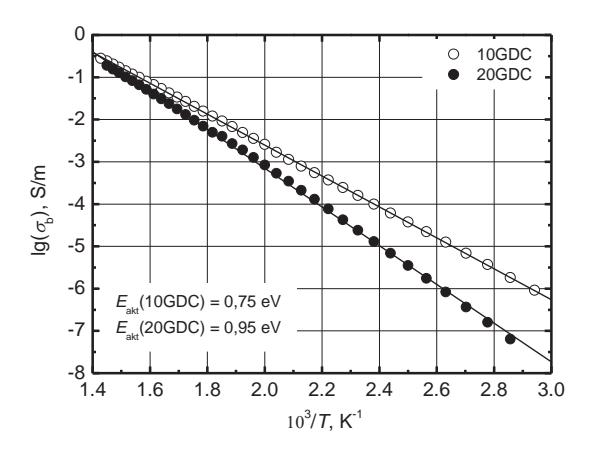
Temperature dependences of ${\sigma}_{b}$ investigated ceramics are shown in Arrhenius plots. 10GDC ceramics shows a 0.28 S/m bulk ionic conductivity at 700 K. 20GDC ceramics shows a 0.19 S/m ionic conductivity at the same temperature. For ceramic compounds 10GDC and 20GDC relative density greater than 94% was achieved.
All investigated ceramics showed results which are appropriate for successful operation as an electrolyte in intermediate temperature SOFCs.