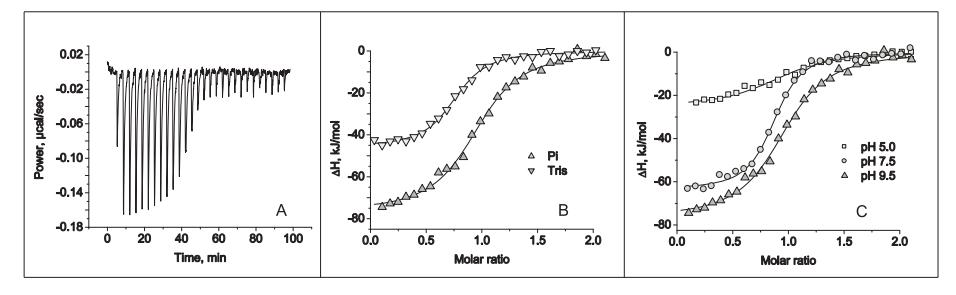
Inhibition of enzymes is important in drug design. Inhibitor interactions with carbonic anhydrases (CA) depend on ionization properties of the inhibitor functional groups and the active site residues in the enzyme. Changes in the protonation of protein, ligand and buffer affect the observed thermodynamic parameters of binding, such as the Gibbs free energy $\Delta G$, enthalpy $\Delta H$, and entropy $\Delta S$. Each binding reaction should be dissected in order to determine the intrinsic thermodynamic parameters that are independent on experimental conditions.
In this work, we present the evaluation of linked protonation reactions upon sulfonamide inhibitor binding to human CAs. There are 12 catalytically active CA isozymes in human body and most of them have been established as therapeutic targets and the sulfonamide inhibitors have been used as diuretics, antiglaucoma agents, antiepileptics, and anticancer agents [1]. The inhibitor binding affinity to a CA was determined using isothermal titration calorimetry (ITC) and the thermal shift assay (TSA, also called ThermoFluor®). ITC is a powerful technique for direct measurement of observed thermodynamic parameters ($\Delta G$, $\Delta H$, and $T\Delta S$). TSA is a rapid and sensitive tool to monitor protein stability and determine the Gibbs free energy of inhibitor binding to enzyme. The combined use of these methods provides a detailed picture of the thermodynamics of the protein-ligand interactions.