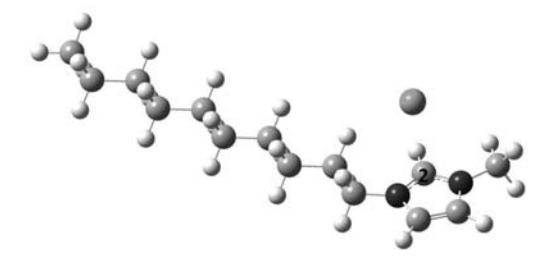
Nuclear magnetic resonance spectroscopy, most commonly known as NMR spectroscopy, can provide detailed information about the structure, dynamics, reaction state, and chemical environment of molecules. Differences between isotropic values of nuclear magnetic shielding tensors, the so-called chemical shifts, are most common observables in the NMR spectroscopy. Experimentally, a curious behavior of the H-1 NMR spectra of 1-decyl-3-methyl-imidazolium ([DMim]) molecule (Fig. 1) - a popular cationic component of imidazolium based ionic liquids – dissolved in solvents of varying polarity was recorded: the increasing shielding of the proton at the 2nd position of the imidazolium ring was observed with the rising polarity of the solvent [1]. In this study, we are trying to calculate the H-1 NMR spectrum of [DMim] molecule in different solvents using density functional theory (DFT) methods as well as polarizable continuum model (PCM) to account for solvent effects. In order to be selected reliable DFT functional and basis set, we have performed a series of test calculations using different DFT methods and basis sets, and compared the results to the corresponding high-level ab initio predictions. Tryout system was 1,3-dimethyl-imidazolium cation. In this presentation, we will compare calculated and experimental H-1 NMR spectra of [DMim] molecule in solvents of varying polarity and we will assess the suitability of the adopted approach to predict H-1 NMR spectra of ionic liquids.