Hydrogen can be produced from many different sources (e.g. biomass rich in carbohydrates) and in various ways. For hydrogen production in dark fermentation process most commonly used are carbohydrates containing substrates [1].
One of the substrates that can be effectively used for microbial hydrogen production is crude glycerol, which is a by-product from the process of biodiesel production. Because of large quantities of available crude glycerol and the highly reduced nature of carbon in glycerol per se, microbial conversion of it seems to be economically and environmentally viable possibility. Such industrial organic waste product as crude glycerol is perspective for usage in feedstock for hydrogen producing bacteria. The process of biodiesel production results in 41% (w/w) of crude glycerol [2].
Different bacterial isolates (from Microbial Strain Collection of Latvia) were tested for hydrogen gas production in order to find the most effective and suitable bacterial culture for crude glycerol usage. Substrate was sterilized through membrane 0.2μm filter. Substrate concentration was measured by HPLC (High Performance liquid chromatography).
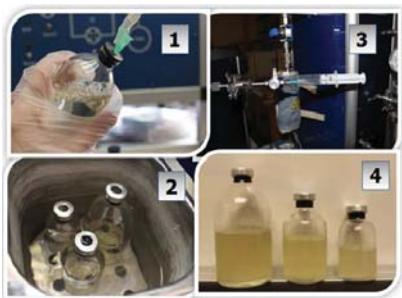
Bacterial cultures were inoculated in 200 ml flasks containing LB (5 g/l yeast extract, 10 g/l tryptone, 10 g/l sodium chloride, 15 g/l Bacto agar). The flasks were aerobically shaken at 37°C for 12 hours at 150 rpm using a multi-shaker PSU-20 (BioSan, Latvia). The bacteria cell number in the overnight culture was titrated at 10-6 dilution. The overnight culture in LB liquid medium was mixed (1:1) with phosphate buffer saline (PBS) pH 7.3 (0.8 g/l NaCl, 0.2 g/l KCl, 1.43 g/l Na2HPO4, 0.2 g/l KH2PO4 [3] in a vessel sterilized for measurements. The PBS contained a complex trace element medium pH 6.5 (0.039g/l Fe(NH4)2SO46H2O, 0.172 mg/l Na2SeO3, 0.02 mg/l NiCl2, 0.4 mg/l (NH4)6Mo7O24 [4]. Argon gas bubbling through the media was used to sustain anaerobic environment.
Evolved gases were collected with the syringe from the tests system serum bottles and tested qualitatively in the mass-spectrometer. Serum bottles were closed with butyl rubber stoppers and aluminium caps. Before use, the bottles were flushed with Argon gas and autoclaved for 60 min at 121°C. Gas concentrations were measured with masspectrometer RGAPro-100.
Results in the report will be discussed in detail.