
Organic semiconductors have recently been used as the transduction material in X-ray detectors. However, these devices have quite low sensitivity because of low attenuation coefficient of thin organic layer. We tried overcome this problem by introducing dense high atomic number (Z) particles, which may increase X-ray attenuation, into organic hole transport material [1].
The ability for a certain material to attenuate X-rays is called the attenuation quantum efficiency (QE) and can be expressed by equation [2]:
$$QE = (1 - e^{-\frac{\mu}{\rho}\rho x})100\%$$Here $\mu/\rho$ is the mass attenuation coefficient, obtained from a photon attenuation database [3], and $\rho$ and x are the density and thickness of the material, respectively.
Into hexaryldiamine (HADA) the various concentrations of ZnCdS (ZCd = 48) were added to form X-ray sensitive layers by thermal fusion. Optimal fusion temperature of HADA is estimated 210 °C.
The X-ray photocurrent measurements of the devices were completed using 8 keV K\alpha X-rays from a copper target (PHYWE Instruments). In 2kV/cm electric field the 42 pA, 102 pA and 188 pA photocurrents have been measured for pure, 25% and 50% ZnCdS concentration layers respectively. The signal-to-noise ratio is defined by the ratio between the corrected X-ray photocurrent and the dark current. Best result 80 dB was obtained for layer with 25% of ZnCdS. For pure and 50% ZnCdS layers it varied between 10 and 20 dB.
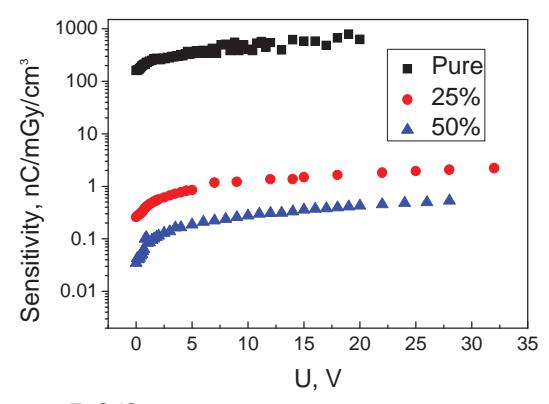
According to XCOM model [3] quantum efficiency for various concentration layers are respectively 0.4%, 21%, 48% for pure($\blacksquare$), 25% ($\bullet$), 50% ($\blacktriangle$) layers. Although photocurrent of higher concentration layer is higher the effect for sensitivity is opposite.