
Carbonic anhydrases (CAs, EC 4.2.1.1) are ubiquitous metalloenzymes, taking part in many essential functions in human organism. CAs catalyse a simple physiological reaction: the conversion of CO2 to the bicarbonate ion and protons (CO2 + H2O ↔ HCO3- + H+)[1]. Humans have 12 active CA isoforms widespread in many tissues and organs. Their activity and distribution in cells are different. Many of the CA izozymes are important therapeutic targets to treat a range of disorders including glaucoma, obesity, epilepsy and cancer [2]. A well-known class of CA inhibitors is sulfonamides. Although, a wide range of sulfonamide inhibitors have been developed, most of them lack selectivity to different CA isozymes. Today there are at least 30 inhibitors used in the biomedical applications, however none of them is selective for specific isozyme. That is why searching for novel specific inhibitors of human CA is an attractive strategy to create new pharmacological tools. The structure – activity relationships (SAR) of designed inhibitors require detailed thermodynamic characterization of the binding reaction [3]. Only intrinsic parameters could be used in the rational design and SAR of the novel inhibitors.
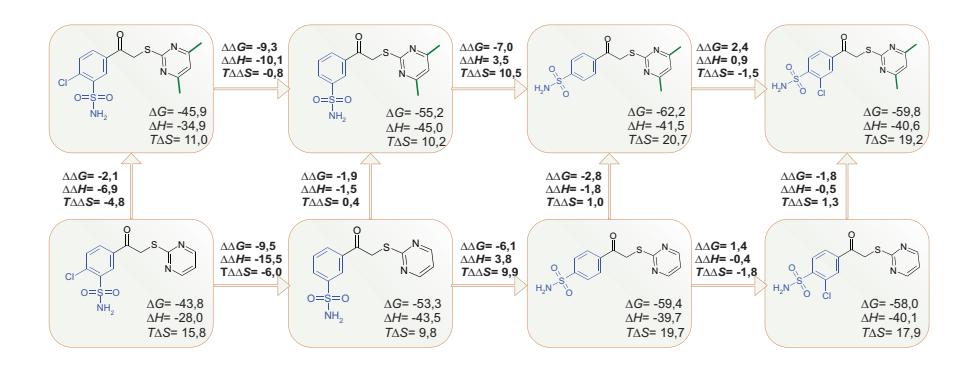
Intrinsic binding parameters for [(2-pyrimidinylthio)acetyl]benzenesulfonamides binding to recombinant human CA I, CA II, CA VII, CA XII, CA XIII izosymes were determined. Gibbs free energy, enthalpy and entropy were measured using thermal shift assay (TSA) and isothermal titration calorimetry (ITC). Determination of the inhibitor binding thermodynamics enables correct analysis of SAR and rational design of novel CA inhibitors.