Highly reflective mirrors are commonly used in laser gyroscopes, high sensitivity spectroscopy, high power lasers, etc. Accurate determination of such mirrors reflection coefficients is important and often challenging task. Currently, the most reliable widely used method for precise measurements of high reflectivity is Cavity Ring-Down (CRD) technique. It is highly sensitive laser measurement technique with immunity to the power fluctuation of light source and rather simple experimental set-up.
CRD is based upon determining the exponential decay of laser pulse in a stable optical resonator. Measured decreasing light intensity can be described by formula [1]:
$$I(t) = I_0 \exp\left(-\frac{t}{\tau}\right),\tag{1}$$where $I$ is light intensity, $I_0$ – initial light intensity, $t$ – time, $\tau$ – time taken for the intensity of light to fall to $1/e$ of the initial intensity or so called ring-down time which can be expressed as
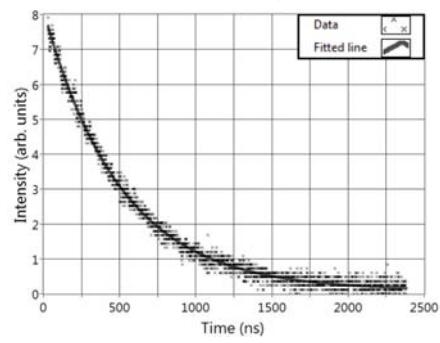
$$\tau = -\frac{2d}{c \ln R_1 R_2} \, \tag{2}$$where $d$ is cavity length, $c$ – speed of light, $R_1$ and $R_2$ - reflection coefficients of cavity mirrors. Reflection coefficients of cavity mirrors are determined by fitting parameters of Eq. (1) to measurement data (Fig. 1.).
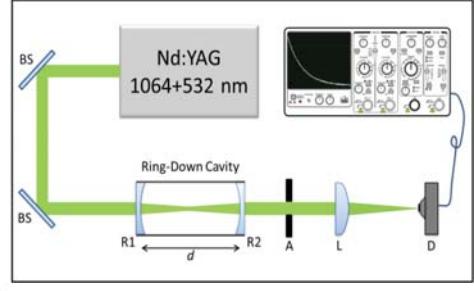
In this work pulsed-CRD experimental scheme (Fig. 2.) was set-up. Pulsed Nd:YAG laser source generating wavelength of 1064 nm was employed. Second harmonic with a wavelength of 532 nm was generated for the experiment. For ring-down cavity plano-concave mirrors were used. High reflectivity optical coatings ($R > 99.5\%$) were produced by using ion beam sputtering (IBS) technology on fused silica substrates. Measurement sensitivity to cavity length and laser source power was investigated. The variation of measured reflectance coefficients of the order of $0.01\%$ was obtained. Various resonator configurations were tested by using different types of substrates. Measurements showed that the results are independent of cavity geometry and configuration. The influence of defects in optical coatings and dust particles to measured reflectance coefficient was observed. Significant decrease in measured values of reflectance coefficients was noticed, because of the increased losses.