Photonic crystals are periodic dielectric structures that have been an object of great interest for over two decades. The spatial periodic modulation of the refractive index inside such structures enables the presence of photonic bandgaps. Such photonic bandgaps allow the realization of photonic crystals as temporal light filtering devices, by allowing the propagation of light whose wavelength does not correspond to forbidden Bloch modes [1]. Recently the appearance of photonic bandgaps for certain geometries of photonic crystal structure has been predicted that would allow such devices to function as highly compact spatial beam filtering devices [2].
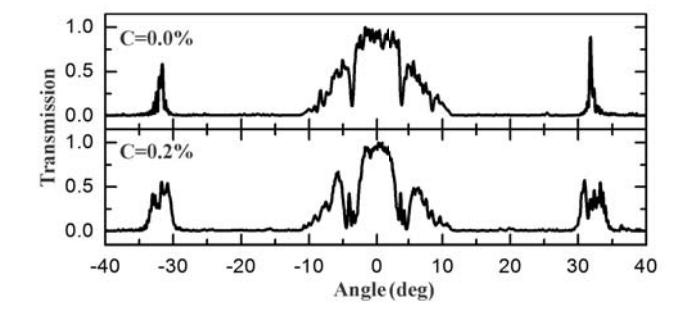
In this report, we present experimental proof of improved filtering efficiency by using a modified known photonic crystal geometry (2D woodpile), that does not posses a photonic bandgap. Such gapless crystals have been predicted theoretically and are characterized by the fact that they do not require as large longitudinal periods or as high refractive index modulation as the gap-based crystals [3], therefore can be realized with less technological difficulty. Due to the lack of a bandgap such crystals suffer from the effect of reversed scattering, when light propagates over too many crystal layers, which is a result of mode coupling. In order to reduce unwanted mode interactions and increase filtering angles, in addition to other filtering parameters, we employed linear modulation of the longitudinal crystal period (chirping) [3]. First experimental proof of an improved filtering effect in chirped gapless photonic crystals is introduced.
Photonic crystals were fabricated under different conditions and with different geometric parameters by utilizing the method of direct femtosecond laser writing technique [4] inside soda-lime glass samples. After fabrication crystals were irradiated with a focused 633 nm laser beam and the far field spatial (angular) intensity distribution behind the crystal was measured. The improvement of filtering efficiency and increase in filtering angles in comparison with the unchirped crystals have been observed and are in sufficient agreement with the theoretical values.