
Phenomenon of magnetostriction permanently attracts attention of physicists and engineers from perspective of design of new instruments and technical devices. Magnetostriction provides possibility of measurement of various physical quantities including stress, strain, elastic properties of materials, magnetic fields, magnetization etc. Magnetostrictive effect is used in various transducers and sensors. Magnetostrictive transducers are used in ultrasonic nondestructive evaluation as broadband sensors of vibrations and in acoustoelectronics as filters and resonators. Magnetostrictive sensors of level are widely used for measurement of gasoline level in underground reservoirs of gas stations. Magnetostrictive materials are also used for energy harvesting and in precision actuators for micro- and nanopositioning. In all above-listed applications one should know magnetostrictive properties of material used in sensor or actuator in order to provide highest efficiency of its operational characteristics.
There are several methods for measurement of magnetostriction [1]: method of electric wire strain gauges, hydraulic method, method of mechano-optical lever, interference method, measurement by means of ferroelectric transducer. The main drawback of the above-listed methods consists in the need for measurement of small deformations of the sample and application of highly-sensitive sensors of deformations.
This work considers measurement of magnetostrictive properties of materials by means of ultrasonic method. This method is based on generation of longitudinal standing ultrasonic wave in the sample of studied material made in the form of bar with constant diameter. Ultrasonic wave can be generated by means of piezoelectric transducer and preferably have frequency in the range 20-40 kHz. Length of the sample should be no less than half-wavelength of ultrasonic waves at the given frequency. Inductive sensor used for measurement is placed in nodal plane of vibratory displacements. Sensitive element of the sensor is made in the form of planar inductive coil generating EMF during vibrations of the sample. Generation of EMF is related to inverse magnetostrictive effect consisting in alteration of sample magnetization during its deformation. Application of planar coil provides spatial resolution (locality) of measurements, i.e. possibility of measurement of magnetization change in any arbitrarily chosen section of studied sample. Sensor is placed in the node of vibratory displacements, since it corresponds to maximum (antinode) of vibratory stresses (Fig. 1).
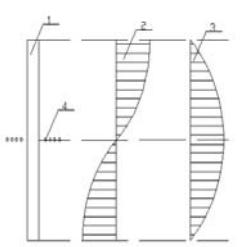
Sensitivity of the sensor can be calculated using amplitude of vibratory stresses and amplitude of EMF generated in output of the sensor. Amplitude of vibratory stresses $\sigma$ can be related to the amplitude of vibratory displacements $\xi$ by means of equation $\sigma$ = kE$\xi$, where k = $2\pi f/c$ is wavenumber, f is frequency, c is speed of sound, E is elastic modulus. Amplitude of vibratory displacements is measured by means of microscope and can be made relatively large in comparison with deformations generated during traditional measurements of magnetostriction. Since sensitivity of the sensor depends on magnetostrictive properties of material, we can determine these properties from the sensitivity calculated by means of above-described algorithm. Sensitivity of the sensor also depends on frequency of vibrations and number of turns of inductive coil. This enables measurement of weak magnetostrictive properties, when sufficiently large frequency of vibrations and number of turns are provided. For example, we successfully measured magnetostrictive properties of 316L stainless steel.