
Nowadays one of the mostly occurring human death causes is disorder of cardiovascular system. Therefore it is actual to find new or improve existing methods of human blood circulation system assessment. Examination of human body requires non-invasive, reliable and very sensitive method which could allow us to recognize the very first indication of a disease. Blood circulation system generates various signals (electric, acoustic) that carry considerable information on the system state. And it is well known that fluctuation of the signal can give valuable information that is unattainable by investigation of averaged values [1]. In this report we present the investigation of fluctuation of human limb impedance.
A new approach in the investigation is analysis of noise characteristics of electrical signals of human body limbs. Voltage fluctuations are measured via two terminals that are attached to a hand (Fig. 1). Voltage fluctuation spectral density is evaluated through comparison with the thermal noise of standard resistor $R_e$:
$$S_V = \frac{\overline{V^2 - V_s^2}}{\overline{V_e^2 - V_s^2}} 4kT_0 R_e \ [V^2 s];\tag{1}$$where $\overline{V^2}$, $\overline{V_S^2}$ and $\overline{V_e^2}$ are the investigated object, the measuring system, and the standard resistor thermal noise variances in the narrow frequency band $\Delta f$; $T_0$ is the absolute temperature of the standard resistor. The experiments are being conducted in Faraday's cage (an enclosure formed by two screens of copper and iron) in order to filter extraneous signals. Due to the fact that investigation results depend on such factors as human age, skin moisture, physical state and environmental conditions, incredibly huge database must be accumulated and carefully analyzed.
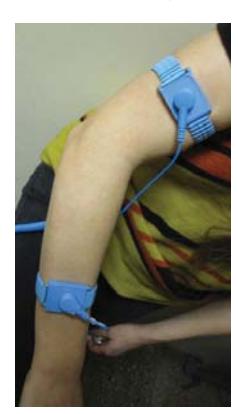
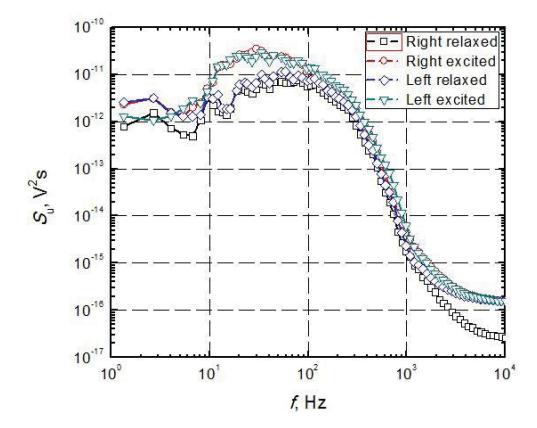
In Fig. 2, there is shown spectral density dependencies on frequency of voltage fluctuation in both hands of a person under study at relaxed and excited (after a series of sit-ups) states. It is seen that in excited state noise spectral density is about half of order larger comparing to the relaxed state. It is observed that noise level in relaxed state slightly differs for different persons but noise level increase at exited state is observed for all investigated cases.
These preliminary investigations enable to assume that fluctuation analysis can be employed for a human cardiovascular system assessment. For the further investigations of human blood circulation system there should be evolved the measurement technique that works at very low frequencies concerning the characteristic times of processes in human body.