
Near infrared two-photon excitation has been a research focus since it became evident that deeper penetration in tissues for imaging and sensitization applications is only accessible within the spectral therapeutic window of 700-1200 nm. The interest in nanoparticles has increased rapidly because of the specific characteristics useful for imaging and treatment of various oncological diseases and cancer. However photophysical properties upon two-photon excitation (TPE) of nanoparticles are yet poorly investigated (Fig. 1).
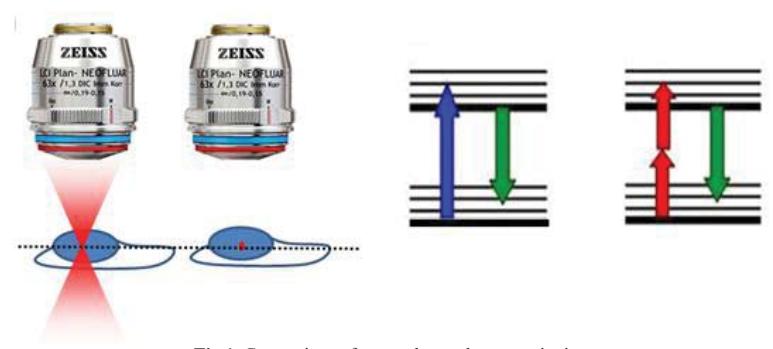
Experiments were carried out on bovine serum albumin (BSA) coated-gold nanoclusters (Au NCs) (synthesized from HAuCl4 (Sigma-Aldrich, Germany)). TPE of samples was performed by using laser system PHAROS (1030 nm, 280 fs, Light Conversion, Lithuania). Two-photon absorption (TPA) cross sections were evaluated by a comparative method with rhodamine B as reference compound [1].
Photoluminescence spectrum measured upon TPE of BSA-Au NCs exhibited intensive band at 665 nm. TPA cross sections of these nanoparticles were compared with the conventional fluorescent organic molecules. Our results confirm that BSA-Au NCs have high enough TPA cross sections compared to organic dyes and therefore can be used as potential two-photon absorbing agents in cancer diagnostics and therapy.