
Spectroscopic ellipsometry is a leading optical technique for the direct investigation of the dielectric function of solids. Spectroscopic ellipsometry measures the change in polarized light upon light reflection on a sample. When linearly polarized light is reflected by a sample surface, its polarization state changes to an elliptical polarization. Ellipsometry measures two parameters of the polarization, $\Psi$ and $\Delta$, which represent the amplitude ratio $\Psi$ and the phase difference $\Delta$ for p- and s-polarized light waves [1]. There are several commercially available spectroscopic ellipsometry instruments, operating at given spectral ranges. However, for detailed studies of optical transitions in semiconductors, the standard specifications usually are not sufficient, one, e.g., needs the wide spectral range, the high spectral resolution and possibility for low-temperature measurements.
In this work we present home-made spectroscopic ellipsometry setup based on rotating analyzer configuration (RAE) and operating in the vertical optical configuration. The principal scheme of the RAE ellipsometer is presented in Figure 1. The key parameters of the RAE ellipsometer are the following: the spectral range 210 – 3000 nm with step of 0.01 nm, the angle of incidence in the range of $10^{\circ}$ – $90^{\circ}$ with an accuracy of 0.01°, and the $\sigma_{\Psi}$=0,09° and $\sigma_{\Delta}$=0,16° registration precision of the ellipsometric parameters, as determined in straight through configuration.
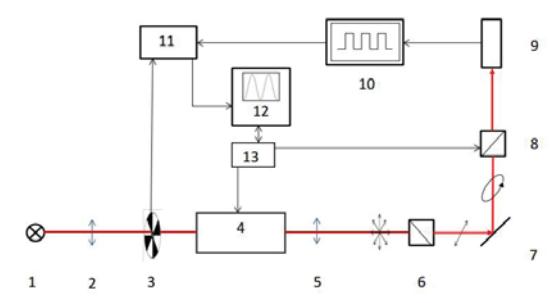
The spectroscopic ellipsometry setup was used for studies of an optical response of GaBixAs1-x semiconductor. The ability to tune energy spectrum of GaBiAs through careful control of the alloy composition makes the semiconductor to be a perspective candidate for various optoelectronic applications, such as the long-wavelength emitters and detectors as well as the spintronic-related devices. The GaBixAs1-x samples were grown in a solid-state MBE system [2] on a low-temperature GaAs buffer layer, deposited on a semi-insulating (100) GaAs substrate. The Bi content varied from 0 (pure GaAs) to 13% (x = 0.013). The ellipsometric measurements show that the interband optical transitions at various critical points depend on Bi content. The incorporation of dilute concentration of Bi into GaAs induces a strong reduction of the band gap ($\sim 60$ meV per x = 0.01) and enhances the spin-orbit splitting in accord with previous results [3].