
The manipulation of donor electron wave functions by the electric field near an interface between two materials can be considered as a basic element for the development of quantum informatics devices. This problem was investigated earlier in works [1-4] using variational methods. In the given work main characteristics of such a system with electric field applied by a disc-shaped gate are studied using finite element method (FEM) and variational method.
One of the most important characteristics describing the given system is a critical potential $(\Phi_{0C})$ - the gate potential which corresponds to the electron transferring from the donor to the gate. The main aim of this work is to study effects of different geometrical parameters on the critical potential.
The problem is formulated as follows: the area z > 0 is filled with a semiconductor and a thin disc-shaped gate of a diameter d and potential $\Phi_0$ is situated on the plane z=0. The center of the gate is positioned at the origin. A donor is located at the distance $z_0$ from the semiconductor interface.
To calculate the electron wave function $\psi$ and energy E the following eigenvalue problem should be solved:
$$(\hat{T} + \hat{V}_D + \hat{V}_{D'} + \hat{V}_{im} + \hat{V}_G)\psi = E\psi, \quad \rho > 0, z > 0,\tag{1}$$ $$\psi|_{z=0} = 0, \quad \psi \xrightarrow[\rho \to \infty]{} 0, \quad \psi \xrightarrow[z \to \infty]{} 0.\tag{2}$$where $\hat{T}$ - the kinetic energy operator, $\hat{V}_D$, $\hat{V}_{D'}$, $\hat{V}_{im}$ - the interaction between the electron and the donor, the donor image and electron image respectively, $\hat{V_G}$ describes the potential landscape in the semiconductor due to the gate.
The problem (1) - (2) has been solved using finite element method and Ritz method with the following trial function:
$$\psi_{\Sigma} = C_G \psi_G + C_D \psi_D, \qquad \tag{3}$$where the term $\psi_D = Nz \exp\left(-\sqrt{(z-z_0)^2 + \rho^2}\right)$, and $\psi_G = C_1 z \exp(-\alpha_1 \rho^2 - \beta_1 z^2) + C_2 z \exp(-\alpha_2 \rho^2 - \beta_2 z^2)$ (we consider $\langle \psi_i | \psi_i \rangle = 1$, $i = D, G$). The ground ($E_0$) and first excited ($E_1$) state energies, calculated with the trial function (3) and FEM, for different values of the gate potential are represented in figure 1.
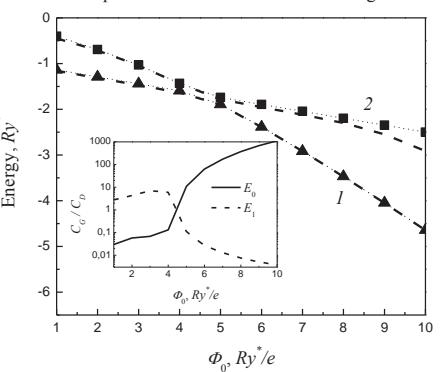
The value of the critical potential $(\Phi_{0C})$ can be calculated in two ways. Firstly, $\Phi_{0C}$ corresponds to the point of minimum distance between the curves, describing the dependences of the ground and first excited state energies on the gate potential. Secondly, the critical potential can be found as the point where $C_G/C_D=1$ for both ground and first excited states (the inset of figure 1).
Using this two methods of evaluating the critical potential we have studied the effect of varying several geometrical parameters (donor depth, gate diameter) on the value of $\Phi_{0C}$. It was found that these parameters strongly influence on the critical potential, and the dependence of $\Phi_{0C}$ on d is not monotonous.
An anticrossing behavior, demonstrated by the ground and first excited state energies, was also observed for higher excited states.