
Today intense ultrashort light pulses' interaction with matter is still a hot topic in optics despite decades of studies. One of the most exciting phenomena is white-light continuum (supercontinuum or SC) generation, which is manifested by large asymmetric spectral broadening. Supercontinuum generation is governed and accompanied by many nonlinear effects, such as pulse-splitting, filamentation, multiphoton absorption, X-waves, soliton formation and others.
For a long time, 800 nm and 1064 nm pulse wavelengths were dominantly used [1], but for now new challenges attract attention, such as infrared (IR) SC generation, which imply longer central wavelengths. The region from 2.5 μm to longer wavelengths (so-called “molecular fingerprint” region) is drawing particular interest for recent studies [2, 3].
The goal of the current study is to compare IR SC generated in several materials and to find some clues on the their applicability for SC generation. 2 μm central wavelength and 30 fs duration pulses, generated by noncollinear beta-barium borate optical parametric amplifier, were used as a pump. Different materials, including calcium fluoride (CF), fused silica (FS) and yttrium aluminium garnet (YAG) were used.
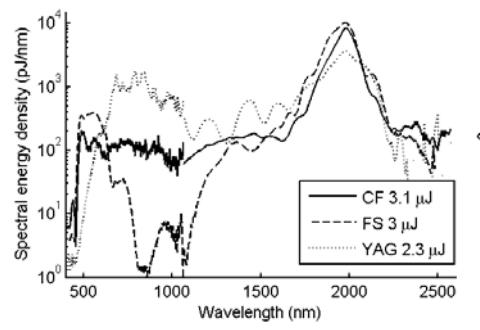
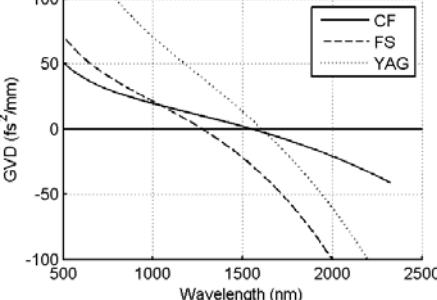
The results show connection between zero-dispersion wavelength and qualitative features of the spectra. Longer anomalous dispersion spectral region is related to long and energetic blue tail formation stop.