
Nowadays ascorbic acid is considered as a promising anticancer therapeutic agent. Ascorbic acid at pharmacological (millimolar) concentrations is ascertained to induce cancer cell death, however its mechanism of action still being undiscovered. Previously in our experiments ascorbic acid has been shown to induce calcium ions release from intracellular calcium stores into cytosol of human larynx carcinoma cells HEp-2c [1]. But whether this ascorbate-induced calcium ions release is associated with Ca2+ efflux from endoplasmic reticulum or from cancer cells mitochondria due to the mitochondrial permeability transition pore opening providing an initial stage of apoptosis is still obscure.
In this study mechanism of calcium ions release, induced by ascorbic acid (5 mM), into cytosol of human larynx carcinoma cells HEp-2c from intracellular calcium stores was investigated. There are two possible intracellular calcium stores (mitochondria and endoplasmic reticulum), which can be responsible for ascorbate-induced calcium ions release. In order to reveal involvement of endoplasmic reticulum in the ascorbate-mediated process mentioned above N-ethylmaleimide (NEM, thiol-alkylating agent) was used. It is established that NEM at low (20-200 μM) concentrations induces Ca2+ release from skeletal sarcoplasmic reticulum vesicles inhibiting Ca2+-ATPases [2]. In our experiments NEM (50 μM) also elicits cytosolic calcium ions concentration increase (27±6 nM) in HEp-2c cells without any influence on the magnitude of ascorbate-induced cytosolic calcium ions release. Moreover addition of NEM after ascorbic acid treatment of cells leads to the same cytosolic calcium ions concentration increase as in experiments without ascorbic acid pretreatment indicating that NEM-induced and ascorbate-induced Ca2+ release into cellular cytosol is associated with depletion of different intracellular calcium stores. These results permit to assume that ascorbate-induced Ca2+ release occurs due to transient mitochondrial permeability transition pore (MPTP) opening. Using fluorescent dye JC-1 (serves for measurements of changes in mitochondrial membrane potential) ascorbic acid is shown to induce loss of mitochondrial membrane potential and mitochondrial redistribution in the cytoplasm of HEp-2c cells (Fig. 1). This consequence is in agreement with the proposal of ascorbate-induced Ca2+ release into HEp-2c cells cytosol from mitochondria as Ca2+ efflux during transient MPTP opening is accompanied by depolarization of the inner mitochondrial membrane [3].
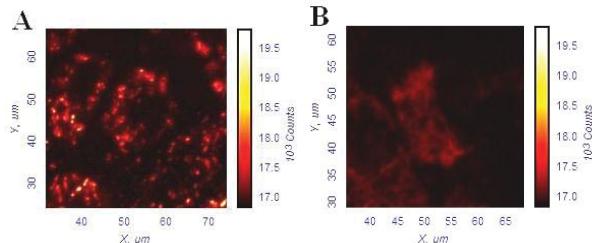
However HEp-2c cells treatment with 5 μM of cyclosporine A (CsA, inhibitor of permeability transition pore opening) has no effect on Ca2+ release induced by 5 mM of ascorbic acid into cytosol. Magnitude of the increase of cytosolic Ca2+ concentration caused by ascorbic acid treatment (5 mM) is not altered in HEp-2c cells treated with 5 μM of CsA for 24 h either. The results obtained indicate that whether ascorbate-induced calcium ions release into cancer cells cytosol occurs due to MPTP opening, mechanism of MPTP formation is CsA-insensitive as described in [4]. To sum up, derived data provide evidence that Ca2+ release induced by ascorbic acid arises from transient calcium ions efflux from HEp-2c cells mitochondria leaving behind several issues opened for further investigations.