
The aim of this study is to investigate the response of a pure bacterial culture (Staphylococcus aureus) placed in broth and saline solutions (0.9 %) to the effect of antibiotics (benzylpenicillinum and gentamicinum) employing a custom built motorized angular white polarized light reflectance measurement stand and a leaky mode diffraction grating sensor chip. Common microbiology tests used for the evaluation of the effectiveness of antimicrobial agents are time consuming while the suggested method provides results in real time. Therefore it is important for pharmaceutical applications.
Various types of evanescent field sensors are widely used in the fields of biology and chemistry, due to their sensitivity and rapid real time detection. Evanescent field probing techniques are based on variations of real or imaginary part of refractive index of the analyte. Such variations cause a certain spectral response (shift in the amplitude or peak position of the reflectance spectrum). Most of these devices are sensitive only in a 100-200 nm range from the interface (restricted by the evanescent field penetration depth), thus the measurements are made by functionalizing the sensor surface with a layer of (bio)active substance. On the other hand, waveguide sensors that exhibit leaky modes are reported to have higher evanescent field penetration depths, therefore they are able to measure processes further away from the interface with greater precision and sensitivity and without the need of activation layer [1].
In this work a sub-wavelength (428 nm) period sinusoidal relief sensor chip was used to monitor the effect of antimicrobial agents. It was fabricated in a diamond like carbon film employing holographic lithography and dry etching [2]. The leaky modes are supported in the waveguide due to periodic modulation and asymmetry of the structure. The sensor chip was mounted in a thermostated measurement cell (20 °C). Reflectance measurements of TM polarization at 14° angle of incidence were performed employing custom built motorized angular reflectance measurement stand and CCD spectrometer (${\lambda}$=360-780 nm) [2]. The analyte was confined within measurement cell and fractions of a milliliter of antibiotics were injected at fixed time intervals. The changes in peak position (see Fig. 1.) and amplitude of the reflectance spectrum were monitored over time.
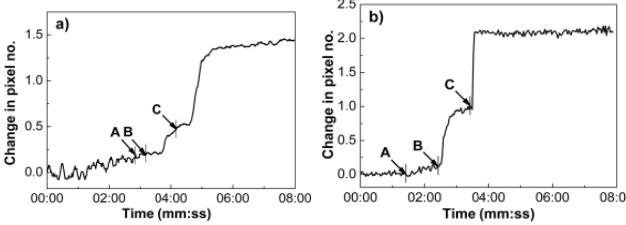
As demonstrated in Fig. 1 the first injection of antibacterial agent causes minimal change in the spectral response of the solution while further injections are followed by a visible change of the peak position in reflectance spectrum. This corresponds to variations in the refractive index of the analyte media due to bacteria eradication by antibiotics. After the third injection all bacteria lysis in the solution may have occurred. This was valid for both antibacterial agents. The eradication of bacteria has been proved by microbiology tests.