
The gravitino is a hypothetical particle postulated in the theory of local supersymmetry (supergravity). It is the superpartner of the graviton and interacts with the other particles only gravitationally [1]. The gravitino acquires its mass after the supersymmetry breaking. Because of the model dependence, the range of allowed gravitino mass is very wide. In various publications it is stated that the gravitino can be either stable or unstable. In our case we assume the gravitino to be stable so that it would be suitable candidate for the lightest supersymmetric particle and so the particle of the dark matter.
We calculate the squared amplitudes and the decay widths for the processes of the gravitino production in the decays of other particles (Fig. 1 and Fig. 2). These amplitudes are suppressed by a factor of the Planck mass-squared.
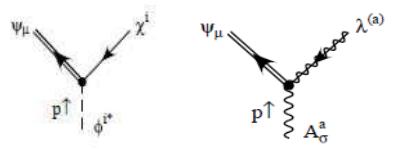
We find the squared amplitudes for the decay of the scalar and vector particles, producing the gravitinos. For example, in case of the sfermion ($\phi$) decay to the fermion ($\chi$) and gravitino ($\Psi$) we find the squared amplitude:
$$ \left\langle \left| M_{\perp}^{2} \right| \right\rangle = \frac{16}{3M_{P}^{2}} \left( \frac{\left[ m_{\phi}^{2} - m_{\chi}^{2} - m_{\Psi}^{2} \right]^{2}}{4m_{\Psi}^{2}} - m_{f}^{2} \right) \left( m_{\phi}^{2} - m_{\chi}^{2} - m_{\Psi}^{2} \right). \tag{1} $$And in the case of vector particle (A) decay to gravitino and gaugino ($\lambda$) we get
$$ \left\langle \left| M_{2}^{2} \right| \right\rangle = \frac{4m_{\lambda}m_{\Psi}m_{A}^{2}}{M_{p}^{2}} + \frac{2}{3M_{p}^{2}} \left[ m_{A}^{2} - \frac{\left( m_{A}^{2} - m_{\lambda}^{2} + m_{\Psi}^{2} \right)^{2}}{m_{\Psi}^{2}} \right] \left( m_{A}^{2} - m_{\lambda}^{2} - m_{\Psi}^{2} \right). \tag{2} $$Together with the gravitino production in the decays, we find the production rate for the gravitinos in case of 2→2 scattering events for gauge bosons- through the interaction of gluons or W+. Contrarily to previous authors [2], we don't use the simplifications and do not ignore any of particle masses in order to define the nowaday gravitino density (at the low energy scale).
When we have all the necessary squared amplitudes, we make the system of coupled Boltzmann-Einstein equations. In this system we include the variation of the Hubble constant, which depends on the scale parameter and the matter content of the universe. We get the relation of the Hubble constant with the densities of particles from the solutions of the Einstein's field equation. We encode all the necessary equations using the Mathematica 7.0 program.
Our next goals are to calculate the collision terms for the particle processes, include them into the Boltzmann- Einstein equations and to solve numerically this system of equations. The solution will show the variation of the gravitino density through the thermal history of the universe and we will get the bounds on the range of the gravitino mass in case of stable gravitino. The results will be published in the final master thesis.