Over the past decade laser systems, emitting ultrashort pulses, have established themselves in the scientific and industrial market. Laser pulses with pulse durations, ranging from a few picoseconds to tens of femtoseconds, have found their applications in medicine, spectroscopy, atmospheric measurements, warfare and etc. One of the most rapidly developing ultrashort laser pulse applications is micromachining. Ultrashort pulse laser systems are powerful tools for micromachining any material, because they emit high energy pulses, which are able to reach intensities needed to induce nonlinear optical processes when focused. Ultrashort pulse micromachining has some advantages over other machining techniques: reduction of heat diffusion around the focal volume, ellimination of plasma absorption and ellimination of material's liquid phase during the interaction of the pulse and matter. These advantages allow creating precise micro/nano scale structures.
Since the invention of the optical fibers they are widely used in telecommunications as the information transferring tools, however, rapidly evolving ultrashort pulse laser systems added a few more applications. Micromachined optical fibers are used as optical gas, temperature, mechanical strain, refractive index change, evanescent field, pressure and etc. sensors [1]. Micro Fabry-Perot [2], Mach Zender, Sagnac interferometers, as well as Bragg diffraction gratings are also formed with laser micromachining – it is clear, that demand of micromachined optical fibers is increasing. There are many publications, describing micromachining of fibers using low, from 1 to 3 kHz pulse repetition rate laser systems [1], but there are almost no publications describing the use of high repetition rate, up to hundreds of kilohertz laser systems, which would allow to significantly increase the micromachining speed and precision. In this work we demonstrate the possibility to precisely form various micro structures in optical fibers using high repetition rate ultrashort pulse laser system.
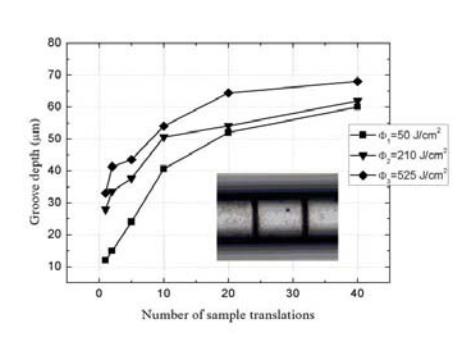
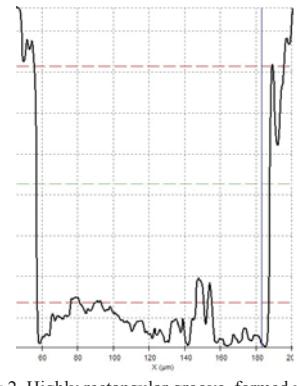
In this experiment a femtosecond PHAROS laser system, emitting 1030 nm wavelength, 300 fs duration pulses with a repetition rate of 100 kHz is used to fabricate microstructures in the multimode quartz fiber. Two different fabrication algorithms are examined, first one being the "repeated line" and the second one – the "repeated rectangular spiral". Laser beam is focused through a 0,42 numerical aperture lens to the surface of the fiber. A view of the micromachined zone is observed with a CCD camera. Results, obtained using "repeated line" algorithm show that a very narrow, from around 2 to 3 μm, and deep, from around 12 to 35 μm grooves can be formed even after single translation of the sample (Fig. 1). A possibility of forming highly rectangular grooves with a surface roughness of ±3 μm, which could be suitable for interferometric applications, was also demonstrated (Fig. 2).