
The thiocyanate – containing metal complexes are considered to be the most investigated systems because of their diverse supramolecular networks and particular properties. The SCN ion is an ambidentate ligand and the final bonding mode depends also on the metal charge, other coordinated ligands and steric effects [1]. To the best of our knowledge we were not aware of data of the assignments of Raman vibrational spectra of [Hg(SCN)]2-n molecules based on theoretical calculations and taking into account a different solvation models. Previously we performed the analysis of calculated and experimental Raman spectra of [Hg(SCN)]2-n complexes in aqueous solution [2]. For better performance of the assignments of fundamental vibrational modes of each [Hg(SCN)]2-n complex as well as verification of the interaction of water ligands with Hg2+ ion, the isotopic substitutions play an important role. It is necessary to know how much each vibrational frequency in a molecule changes when a heavy isotope is substituted for a light one [3]. In this work, we present the results obtained by comparing D2O/H2O exchange influence on the simulated and experimentally observed Raman specra.
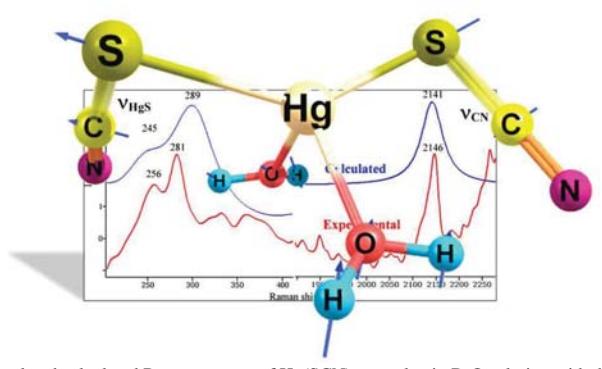
The performed calculations and experimental analysis of H2O replacement to D2O showed that the frequency of $\nu_{\text{C$\equiv$N}}$ stretching vibration of each [Hg(SCN)]2-n molecule is not sensitive to isotopic exchange. However, it is obvious that the isotopic substitution has substantial influence to the $\nu_{\text{Hg-S}}$. It should be noted that the vibrations at the 250 – 300 cm-1 region are complex vibrations of Hg-S and Hg-O stretching. Due to performed calculations and experimental analysis of isotopic substitution, we were able to identify the second $\nu_{\text{Hg-S}}$ vibrational mode in the case of Hg(SCN)2. This double-peak character also was displayed in calculated Raman spectra of Hg(SCN)2 when the solvent is H2O, but could not be observed in the experimental Raman spectra.
Generally the isotopic changes have played an important role in performing better vibrational assignments. The D2O/H2O exchange analysis supported that the Hg2+ ion in the all complexes is four-coordinated. Additionally, it allowed to observe the second $\nu_{\text{Hg,S}}$ vibrational mode which was overlaid by H2O molecules in the case of Hg(SCN)2.