Rapidly growing development in laser physics has led to many applications becoming relevant to the industrial market, and it is expected that the advent of efficient laser sources and the use of materials that exhibit high order nonlinearities should be combined in order to disseminate in new areas. Therefore, the class of nonlinear phenomena based on photorefractive effects in electro-optical crystals will undoubtedly play a major role for modern applications.
Photorefractive effects are based on the transposition of a light pattern into a refractive index pattern. Thus, when coherent high intensity laser beams interfere in the volume of a material, a photoinduced space charge field is generated which modulates a refractive index via the electro-optic effect. The photoinduced change of the refractive index in lithium niobate crystals is reversible and may be optically erased or thermally annealed [1]. This effect in LiNbO3 is of interest for many applications, such as holographic data storage, volume holographic memories, wavelength division multiplexing, optical detection systems of ultrasonic waves, double exposure interferometry, etc [2].
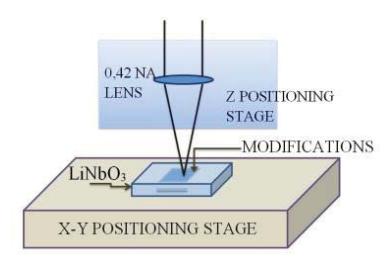
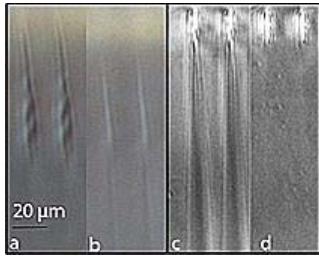
However, the change of the refractive index recorded in LiNbO3 by femtosecond laser pulses has not been studied completely and detailed knowledge about the microscopic processes occurring in these materials is still unknown. For this reason, the main goal of the current research was to induce photorefractive modifications in undoped and lithium niobate doped with iron (LiNbO3:Fe) crystals by illumination with near infrared wavelength (1030 nm), 300 fs pulse duration laser radiation focused through a 0,42 numerical aperture lens to the volume of the crystal (Fig. 1). Also, the dependence of modification appearance on fabrication parameters, such as pulse energy, repetition rate and focusing depth was analyzed. Later, modified crystal was irradiated with intense ultraviolet (UV) light to test modifications stability. Photorefractive modifications induced in pure lithium niobate crystal completely vanish after sufficient UV exposure. In iron-doped lithium niobate case, the erasure of recorded modifications becomes more complicated, as additional zones of modified optical properties start to appear in a laser pulse track almost across all crystal length after UV exposure. These zones indicate that defect-formation is present in the crystal even at low laser pulse energies. We demonstrate that such modifications can be erased using thermal annealing procedure (Fig. 2).