
The detailed understanding of short and very short H-bonds with large-amplitude proton dynamics is challenging task that requires joint efforts of the best available experimental techniques and the most advanced theoretical treatments. Pyridine N-oxide (PyO) or its derivatives in the complexes with various acids can be used as very convenient model systems to improve the understanding of the nontrivial physical features of short H-bonding. v. Such systems exhibit in many cases very asymmetric and rather flat H-bond potentials, which allow large-amplitude proton motion with the possible proton transfer trough such linkages. The literature sources on computations of the IR spectra even for the simplest complexes with a hydrogen bond using the anharmonic approximation are just a few available.
Computations of the spectral and structural characteristics of trichloroacetic (TCA) and PyO·TCA were performed using the package GAUSSIAN 09 in the approximation B3LYP/cc – pVTZ. B3LYP is one of the approaches in a density functional theory designed to include the exchange and electron correlation effects. As shown by our previous studies, computations in the approximations B3LYP/cc – pVDZ and B3LYP/cc – pVTZ reproduce well frequencies of the harmonic vibrations and the shape of the potential-surfaces for some organic molecules. In the process of optimization of the geometry for these compounds, the fact that minima on the potential surface were reached has been supported by the absence of imaginary frequencies in vibrational spectra. IR spectra of these compounds were computed in the harmonic and anharmonic approximations. In case of the latter the frequency shifts of the fundamental vibrations due to Fermi and Darling-Dennison resonances were included as well.
As seen in Fig. 1, X axis is coincides with the hydroxyl bond lying in the plane XOY. It is clear that motion of the hydrogen atom along the axis X may be associated with the stretching vibration, whereas its motion along the axis Y may be associated with the in-plane and along the axis Z — out-of-plane bending vibrations of the hydroxyl group. During the computations it was assumed that motion of a hydrogen atom is independent of other atoms in the molecule within the potential field formed between two oxygen atoms. We have computed the complex energies at more than 300 points by positioning the hydroxil atom H13 at the certain nodes of 1D and 2D meshes, without geometrical optimization of the complex for the remaining geometrical parameters.
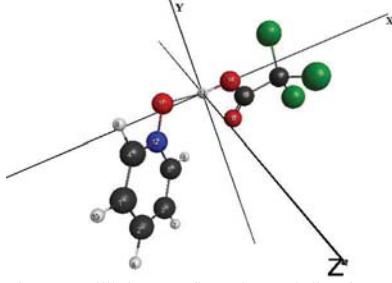
During calculations according [1] the frequencies of hydroxil group vibrations were found in 1D and 2D approaches. The resalts are listed in Table 1.
| Vibrational mods | 1DX (cm-1) | 1DY (cm-1) | 1DZ (cm-1) | 2DXY (cm-1) | 2DXZ (cm-1) | 2DYZ (cm-1) | Harm. (cm-1) | Unharm. (cm-1) |
|---|---|---|---|---|---|---|---|---|
| $\nu_{\scriptscriptstyle OH}$ | 1070 | 1078 | 1057 | 2105 | 350 | |||
| $\delta^{ip}_{O\!H}$ | - | 1395 | - | 1387 | - | 1392 | 1472 | 1414 |
| $\delta_{\scriptscriptstyle OH}^{\scriptscriptstyle oop}$ | 1220 | 1226 | 1220 | 1233 | 1187 |
As one can see from Table1, the anharmonic frequencies of the bend modes of hydroxil group are in a good agreement with our results in 1D and 2D approximation. However, this is not so in the case of stretching vibrations. And since, according to the experimental data maximum of the absorption band associated with $V_{OH}$ is located near 1100 cm-1 it is clear that anharmonic approximation fails to predict the frequency of the stretching vibration of the hydroxyl group in PyO·TCA complex.