
The non-specular reflection of a leaky surface acoustic wave radiated beam from the surface of piezoelectric lithium tantalate crystal has been investigated using an acoustoelectric and acousto-optic technique. The Schoch-type beam displacement upon reflection strongly depends on whether the surface is free or metalized. This effect is attributed to the excitation (on the reflecting surface) of the leaky surface wave [1, 2].
The experimental technique is shown in Fig. 1, where interdigital transducers (IDTs) with a period of 40 μm and 20 electrode pairs were deposited on the top surface of the sample. Laser light with a wavelength of 633 nm from the HeNe laser was directed onto the sample surface. The schematics for parallel polarization ($E_i$) of the incident laser light is depicted in the case (a) and for the perpendicular ($E_i$) in the case (b). As a result of anisotropic light diffraction by the leaky surface acoustic wave radiated bulk acoustic wave, the incident light beam was split into transmitted ($I_t$) and diffracted ($I_a$) beams with mutually orthogonal polarizations. Indices $I_i$ and $I_r$ denote the incident and reflected light beams, respectively.
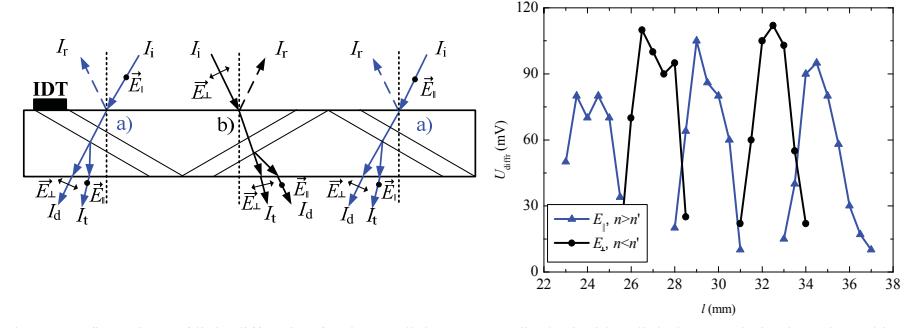
This experiment shows that the acoustic wave reflection from the surface along the substrate X axis is approximately equal for both cases. As seen, the value of the diffracted angle depends on the incident light beam polarization. The extraordinary refractive index for lithium tantalate crystal (2,18) is bigger than the ordinary (2,175). If the phase matching condition is satisfied the peaks of diffracted light signal obtained from the case of a parallel incident light polarization (blue curve) are located closer to the interdigital transducer because of Snell's law. The case of perpendicular light polarization is performed along the reflected BAW from the crystal sample bottom.
A small variation of the diffracted signal amplitude is attributed to negligible attenuation of the bulk acoustic beam along the crystal. This surface wave is a leaky wave; hence, it re-radiates the energy back into the crystal bulk as it travels along the crystal surface. The dependence of diffracted light intensity versus the light beam position yields the acoustic beam intensity distribution along the substrate X axis.
In conclusion, the reflection of leaky surface wave generated acoustic beam from the non-conducting surface of piezoelectric lithium tantalate crystal was investigated. It has been shown that the beam reflected from the free crystal surface is displaced forward as compared to specular reflection. This shift is attributed to excitation of the surface wave and consequent energy re-radiation into the crystal bulk. Such a re-radiation is considerably stronger on the conducting surface leading to the significantly smaller beam shift. The sensitivity of wave reflection to the surface conductivity offers the possibility of implementation of leaky acoustic wave based sensors responding to the changes in surface condition due to various external factors.