Diamond like carbon (DLC) is the amorphous form of carbon (a-C:H), that consists of non-negligible fracture of sp3 bonding [1]. DLC possess many useful properties such as high mechanical hardness, optical transparency, etc. [1], however it has some significant drawbacks like high compressive stresses, gained due to sp3 bonding of carbon atoms. Doping with other elements can improve the original properties of a-C:H films. It was reported that silver inclusions can moderate the mechanical and optical properties of the films [2,3]. Optical properties can be changed in a wide range depending on the Ag concentration. It was shown that incorporation of Ag gives the reduced transparency and optical band gap of the films [3]. This effect was associated with the structural change to sp2 phase. One of the techniques to determine the phase change is Fourier transform infrared (FTIR) spectroscopy. The inclusion of metallic particles into carbon matrix is an additional tool for analysis as metal-surface selection rules for IR absorption must be taken into account [4]. Some absorption bands are strengthened and others are absent or weakened when molecules are adsorbed onto metallic surface or nanometer sized particles [4].
In this work we present an analysis of the structure of DLC films doped with different amount of silver employing FTIR spectroscopy in a 4000 – 400 cm-1 range. Nanocomposites were deposited on quartz by unbalanced magnetron sputtering of silver target. Mixture of acetylene and argon was used in reactive sputtering. Varying Ar/C2H2 gas ratio and deposition time, different silver doping level of DLC films was achieved. Films with Ag content from 0.6 to 34.3 at.% were analyzed.
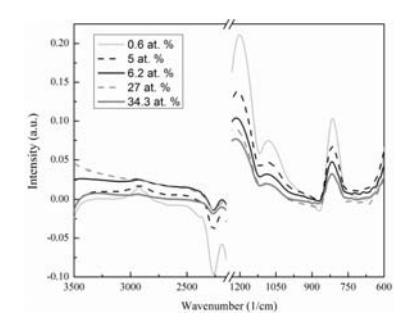
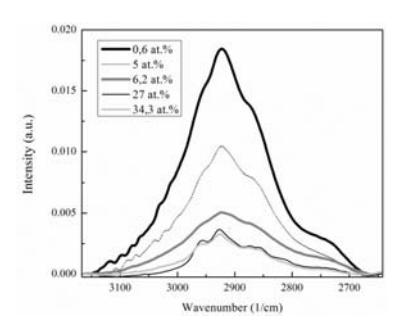
The IR spectra of different films are shown in Fig. 1. The main vibrational bands observed in the spectra were attributed to C-H stretching (3100 – 2800 cm-1), C-H bending (870 – 650 cm-1) and CO2 stretching (2400 – 2250 cm-1). To determine the structure of the films, the C-H stretching region was analyzed in more detail. Fig. 2 shows the region of interest. It was observed that the increase of Ag concentration reduces the intensity of C-H stretching vibration dramatically. Further this peak was deconvoluted into the different C-Hx stretching modes in terms of hybridization and bond configuration and sp3/sp2 ratio was calculated.