
Convection is active in late-type stellar atmospheres and introduces velocity fields, which causes spectral line shifts and asymmetries in the observed spectrum. Convective energy transfer is a common phenomenon in the atmospheres of low-mass stars. Amongst the directly observable consequences related with the convective velocity fields are Doppler-shifts and asymmetries of various spectral lines, that can be detected in stellar spectra of sufficiently high spectral resolution and signal-to-noise ratio. Although such line shifts and asymmetries are routinely observed in the Sun for more than 30 years now, predicting them with a reasonable accuracy became possible only recently with the advances in three-dimensional (3D) hydrodynamical stellar atmosphere models. The comparison of the observed and theoretical spectral line asymmetries and line shifts may therefore provide important insights about the role of convection in the spectral line formation, and may allow to constrain theoretical models by identifying which properties of the model atmospheres are still not realistic enough to stand the test of observations.
Studies of the spectral line Doppler-shifts and asymmetries have been done so far for only a few types of stars (including the Sun, Procyon, several M dwarfs and a metal-poor red giant). In this study we therefore extended the previous work by studying shifts and asymmetries of neutral iron (Fe I) lines in the metal-poor red giant HD 122563. For this purpose we used high quality ($R = \lambda/\Delta\lambda = 115000$, S/N $\approx 310$) archival HARPS spectrum covering the visible wavelength range ($\sim 400 - 700$ nm). 3D hydrodynamical COBOLD stellar model atmospheres were used to synthesize theoretical profiles of the Fe I lines studied in the HARPS spectrum. We further calculated coreshifts 1 and bisectors2 of the observed and theoretical Fe I lines, in order to make a comparison of theoretical predictions with the observed data.
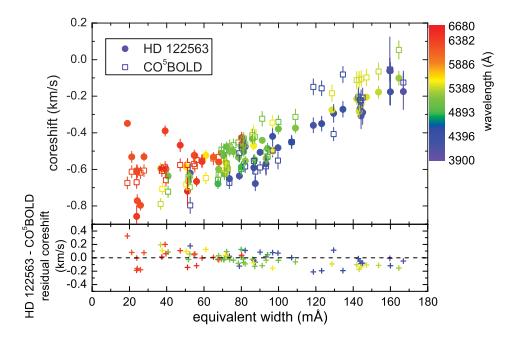
One important result of our study is that both observed and theoretical coreshifts depend on the spectral line strength, so that the coreshifts are largest in case of weakest spectral lines. Theoretical models also predict the dependence of coreshifts on wavelength, slight hints for which can be seen in the observed data too. Generally, theoretically predicted coreshifts agree well the observed ones, although there are hints that model predictions are somewhat worse in case of the weakest and strongest Fe I lines. Observed and computed line bisectors seem to agree well too, except that models tend to predict slightly larger blueshifts for the weakest lines ($\sim 0.1$ km/s).
The obtained results therefore suggest that current 3D hydrodynamical model atmospheres can reproduce the interior structures of a metal-poor red giant HD 122563 sufficiently well. At the same time, refinement of the models is still needed in order to reliably predict asymmetries and shifts of the weakest and strongest Fe I lines. Nevertheless, the very fact that 3D hydrodynamical stellar model atmosphere models are capable of successfully reproducing the observed spectral line asymmetries and shifts may open up entirely new ways to study the interior structures of stellar atmospheres.
1Coreshift is the Doppler shift of the deepest point in the line profile.
2Bisector is a line constructed from the midpoints of horizontal lines connecting the line wings.