First experimental studies of metal impurity levels in semiconductor germanium (Ge) began from 1950s using resistivity and Hall effect measurements. Later when deep-level transient spectroscopy (DLTS) was introduced it became a preferential technique to study the behavior of trap levels in the semiconductor [1].
The aim of this work is to characterize the levels that manganese (Mn - a transition metal in the 3rd series) introduces in germanium. This material is highly applicable for the ferromagnetic semiconductor researches for over 10 years [2].
This work concerns n-type Ge implanted with Mn transition metal samples with the dose of 5*1013 atoms/cm2. After implantation the dopant ions are concentrated in a layer close to the surface, thus, in order to disperse the dopant and to make it active an additional thermal annealing on 500°C was performed. Expected free carrier concentration is Ns = 2*1014cm-3.
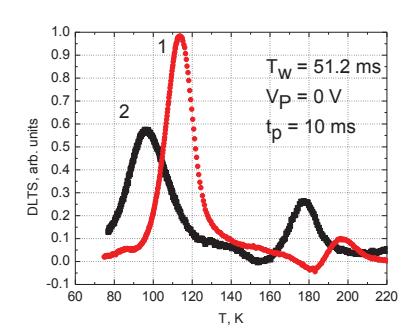
DLTS measurements for the sample of 30 minutes annealing with selected reverse bias VR = -1V is presented in Fig. 1 (1 curve). One can clearly see a peak in the 112K temperature. From Arrhenius analysis obtained activation energy is Et = 0.18 eV. This result is close to the literature value from previously reported resistivity measurement for the Mn implanted Ge (EV + 0.16 eV). However, it has relation with the hole capture in the valence band [3]. Moreover, experimentally we measured Ns = 2.96*1016 cm-3. A value is also confirmed using Hall-Van der Pauw measurements. This is two orders of magnitude higher than the expected result. Furthermore, high Ns affect reverse capacitance (CR) which is also high and yields the 10-9 F order of magnitude.
Fig. 1 (2 curve) shows the DLTS spectrum measured on a smaller sample at a larger VR = -5V, and a correspondingly larger electrical field. One can see that amplitude of the peak at the lower temperature region decreased what can be explained by the decrease of reverse capacitance (CR at -5V is lower than at -1V). Moreover, comparing with the previous measurement the amplitude at higher temperature range emerged and it is more suitable for analysis.
Another effect that can be observed comparing measurements from Fig. 1 is that the peak at 112K (1 curve) shifted to the lower temperatures (96K, 2 curve). This means that trap energy decreases when applied electric field increases. This can be explained by the Poole-Frenkel effect as applied negative voltage creates an electrical field that lowers the potential barrier and because of this, less energy is required to thermally emit carriers. This can only happen if traps are attractive for majority carriers, thus positively charged. Hence, we would have to conclude that the levels we observe have donor characteristic. This does not correspond with the double-acceptor levels that literature suggests for Mn [3].