
Fluorescent organic nano- and microstructures exhibiting the so-called aggregation-induced emission (AIE) phenomenon have recently attracted much attention because of their potential use in optoelectronic devices, such as OLEDs, lasers or sensing systems [1]. Self-assembly of molecules into aggregates in polymer matrix by exposure to organic solvent vapor or by thermal treatment is promising for technological application, e.g. for vapor or temperature sensing kits as it can result not only in enhanced emission but also in a strong blue or red shift of the fluorescence spectra [2].
In this work, fluorescent aggregates based on novel divinylbenzene derivatives with cyano groups were formed directly in a polymer film using thermal treatment and vapor exposure. The aggregates were examined in regard to their morphology and optical properties by various methods such as fluorescence microscopy, spectroscopy and time correlated single photon counting. Additionally, the amplified spontaneous emission (ASE) of the divinylbenzene derivatives dispersed in polymer matrix was observed and ASE threshold values were determined. These derivatives were also used to form fluorescent organic nanoparticles (FONs) by a reprecipitation method in aqueous solution. Isolated molecules in a dilute solution showed very low fluorescence quantum efficiency (0.5%), but upon addition of more than 50% of water volume fraction highly fluorescent (QY=70%) nanoparticles were formed.
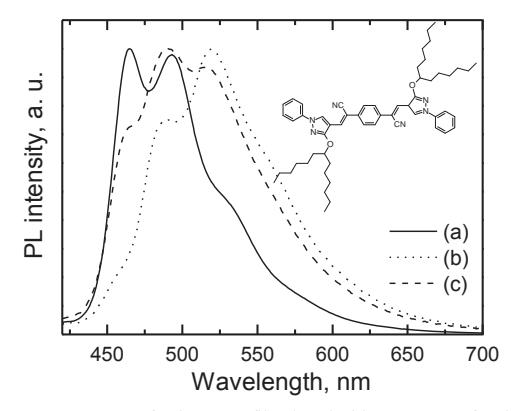
The ability to control the aggregation process by exploiting various end-groups of cyano-substituted divinylbenzene derivatives was demonstrated. The untreated polymer films containing isolated molecules exhibited blue emission, but after the vapor- or temperature-induced aggregation a red shift of the fluorescence spectra was observed due to the specific molecular arrangement in the aggregates (Fig. 1.). The latter result shows promise for the dinvylbenzene-doped polymer films in sensing applications.