
Ferroelectric barium titanate and nickel-zinc ferrite composite ceramics belong to a multifunctional materials group called multiferroics. Multiferroic materials, exhibiting more than one ferroic property (ferromagnetism, ferroelectricity, ferroelasticity) in a single phase has drawn a wide scientific and technological attention in the present years for the fundamental research and due to the variety of possible practical applications. One of the most promising candidates is barium titanate and nickel zinc ferrite composite.
$x$BaTiO3-(1-$x$)Ni0.5Zn0.5Fe2O4 composite ceramics with x=0.5, 0.6 and 0.7 molar ratios were successfully prepared by the co-precipitation method, and from the X-ray diffraction patterns obtained the presence of only the perovskite BT and spinel NZF phases was confirmed [1].
Although dielectric properties of this material were already investigated, the results up to only megahertz frequencies were presented [2, 3]. Here we demonstrate the results of the broadband dielectric spectroscopy in the 20 Hz to 50 GHz frequency range.
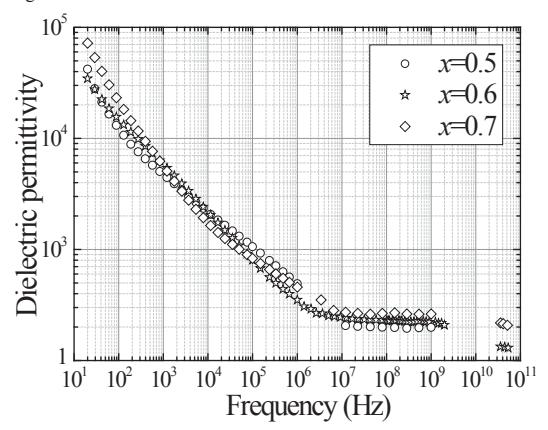
The real part of dielectric spectra of the composite ceramics (Fig. 1) manifests conductivity contribution up to a few megahertz frequencies followed by a relaxation process. Such conductivity behavior must be primarily due to ferrite phase of the composite and it is likely to be related to the Maxwell-Wagner polarization mechanism [4, 5]. At high enough frequencies, where the conductivity contribution is remarkably reduced, diminished permittivity with the increasing concentration of nickel-zinc ferrite can be observed.