FABRICATION AND CHARACTERIZATION OF MICROLENS ARRAYS FOR USAGE IN MULTIFOCUS DIRECT LASER WRITING
Linas Jonušauskas1, Mangirdas Malinauskas1
1 Department of Quantum Electronics, Vilnius University, Saulėtekio Ave., 9, Vilnius LT-10222, Lithuania
Direct laser writing (DLW) technique based on multiphoton polymerization is an emerging micro-and nanostructuring technology that allows fabrication of freeform 3D objects [1] with features as small as tens of nanometers [2]. It was shown that this technology is capable of forming various micro-and nanostructures including photonic crystals [3], scaffolds for stem cell growth [4], microoptical elements [5] or combinations of these structures for specific usage [6].
However, this technology still has some drawbacks that limit its capabilities and wide spread usage. One of them is relatively slow fabrication throughput because of point-by-point fabrication nature. Although some microreplication technologies such as UV lithography [7] or soft lithography [8] could be employed to partially overcome this problem, most of these technologies offer only 2.5D or limited 3D geometrical architecture of replicated structures.
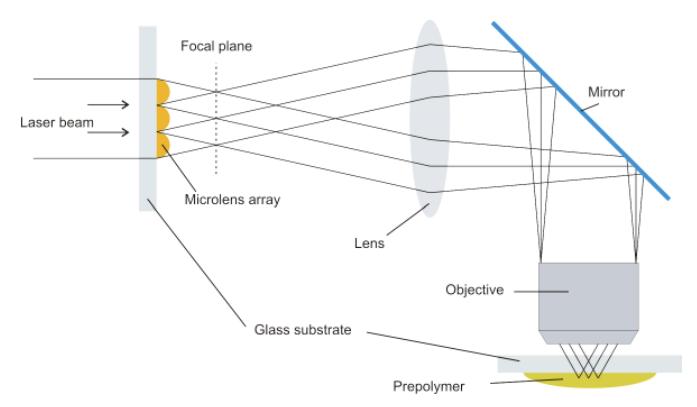
In this work we investigate possibility to increase DLW efficiency by using more than one focal point for microfabrication [9]. This could be achieved by adding microlens array in to DLW setup (Fig. 1). Various microlenses for such application are designed then fabricated using conventional DLW setup and characterized. Possible setup for microlens array positioning in DLW setup is proposed. Attempts to achieve multifocus polymerization are made.
Fig. 1. Basic scheme of optical setup for multifocus polymerization
[1] S. Juodkazis, V. Mizeikis and H. Misawa, Three-dimensional structuring of resists and resins by direct laser writing and holographic recording, Adv. Polym. Sci. 213, 157-206 (2008).
[2] M. Emons, K. Obata, T. Binhammer, A. Ovsianikov, B. N. Chichkov and U. Morgner, Two-photon polymerization technique with sub-50 nm resolution by sub-10 fs laser pulses, Opt. Mater. Express 273), 942-947 (2012).
[3] M. Straub, L.H. Nguyen, A. Fazlic and M. Gul, Complex-shaped three-dimensional microstructures and photonic crystals generated in a polysiloxane polymer by two-photon microstereolithography., Opt. Mater. 27, 359364 (2004).
[4] M. Malinauskas, P. Danilevicius, D. Baltriukiene, M. Rutkauskas, A. Zukauskas, Kairyte, G. Bickauskaite, V. Purlys, D. Paipulas, V. Bukelskiene and R. Gadonas, 3D Artificial polymeric scaffolds for stem cell growth fabricated by femtosecond laser., Lith. J. Phys. 50, 75-82 (2010).
[5] M. Malinauskas, H. Gilbergs, A. Zukauskas, V. Purlys, D. Paipulas and R. Gadonas, A femtosecond laser-induced two-photon photopolymerization technique for structuring microlenses, J. Opt. 12 (2010).
[6] J. Trull, L. Maigyte, V. Mizeikis, M. Malinauskas, S. Juodkazis, C. Cojocaru, M. Rutkauskas, M. Peckus, V. Sirutkaitis and K. Staliunas, Formation of collimated beams behind the woodpile photonic crystal, Phys. Rev. 84, 033812 (2011).
[7] M. Hanm W. Lee, S.-K. Lee and S. S. Lee, 3D microfabrication with inclined/rotated UV lithography, Sensor. Actuat. A-Phys. 111, 14-20 (2004).
[8] Y. Xia and G. M. Whitesides, Soft lithography, Annu. Rev. Mater. Sci. 28, 153-184 (1998).
[9] S. Matsuo, S. Juodkazis, H. Misawa, Femtosecond laser microfabrication of periodic structures using a microlens array, Appl. Phys. 80, 683685 (2005).