
Due to recent success in development and visualization of nanosized clusters and other metallic nanoparticles, a new branch of nanooptics and nanotechnology quickly develops — nanoplasmonics. The most important feature of nanoplasmonic devices is the combination of strong electromagnetic oscillation localization combined with high frequencies of these oscillations, which in turn leads to a gigantic amplification of local optical and electromagnetic fields [1]. The localized plasmons parameters depend on the shape of the nanoparticles, which allows to fine-tune their resonance system to effectively interact with light and other quantum systems (quantum dots, molecules) [2].
Some of the possible applications of these effects are highly effective attunable fluorophores and nanosized light sources, as well as surface plasmon amplification by simulated emission of radiation. It is also possible to create micromechanical oscillators (Fig. 1), using highly conducting microcantilevers and carbon nanotubes as mechanicaly floating gates [3]. Such devices are shown ot exhibit not only mechanical resonance, but also resonance at frequencies of plasma oscillations.
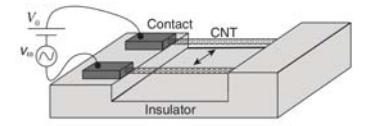
In detectors, such as the one presented above, it is possible to indeuce a parametric balance if the amplitude of the imput signal exceeds some threshold value. When this happens, low frequency mechanical vibrations are induced in the resonator, even in the abscence of the carrier frequency modulation [4]. Presenting the plasma and mechanical distributions of the resanators as lumped parameters, it is possible to write out a set of equations for associated resonators, the solution of which will allow to evaluate the threshold value of the input signal: Eq. (1):
$$y'' + \gamma_m y' + \omega_m^2 y = -\frac{2\eta\rho}{M_l d}\ \rho'' + \gamma_e \rho' + \omega_e^2 (1 + \zeta \frac{\nu_{eD}^2 y}{\nu_{eD}^2 d}) \rho = \frac{4}{\pi} \omega_e^2 C_l \delta \phi(t)\tag{1}$$This work is an attempt to estimate the threshold amplitude of the AC input signal, exceeding which results in self-induced mechanical oscillations.