
One of the main problems in laser physics is tuning of laser radiation frequency. There are many ways developed to do that (e.g. second and higher harmonic generation, Brillouin and Raman scattering, free electron lasers and parametric light generation and amplification). The purpose of this work was to construct parametric light generator pumped by 1064 nm laser beam and effectively generate signal beam in 1500 nm region. Then amplify the signal and analyze its properties.
Most of the recent works in this area use 532 nm laser beam as pump source, e.g. [1] achieved broad tunability from 750 nm to 1040 nm. But we chose 1064 nm pump beam, which allowed us to achieve signal beam in 1500 nm region where light radiation is less harmful for human eye. The experiment was divided into two steps: first – constructing standing wave OPG (optical parametric generator); second – using traveling wave OPA (optical parametric amplifier) to amplify the signal wave.
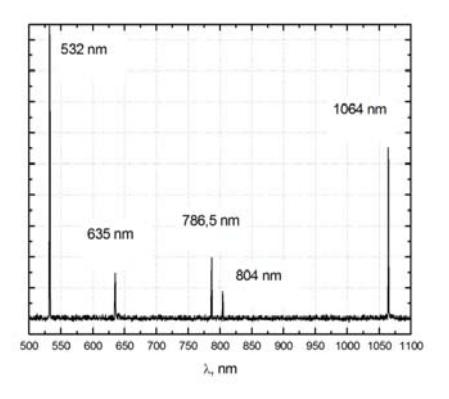
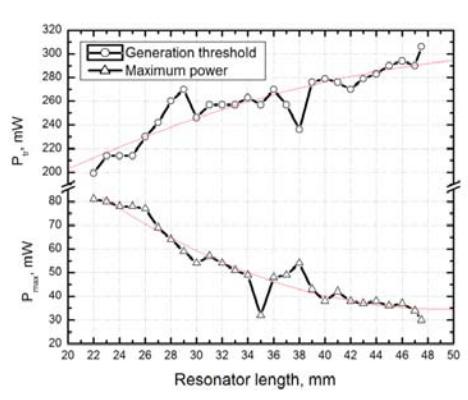
In first part we constructed half confocal OPG with resonator length of 22 mm using a 20 mm KTP crystal. Signal wavelength was 1573 nm and energy exchanging efficiency was 20,09 % (with pumping power of 400 mW). The spectral distribution of OPG in visible light region is shown in Fig. 1. We also analyzed maximum efficiency's and generation threshold's dependency from resonator length. The results are presented in Fig. 2.
Second part of the experiment used traveling wave OPA to amplify current signal. Achieved energy conversion ratio was 34% (representing amplification from 25 mW to 110 mW, with pump power of 270 mW). The resulting beam was high power and ready for further analysis or usage.
For further development of this experiment using the same system we will construct OPG pumped by multiple pump waves (similar as described in [2], [3] and [4]) and instead of ordinary KTP crystal we will use periodically-poled PPKTP crystal (as described in [5]).