
Fast microfabrication of transparent materials is becoming essential due to increasing industrial requirements of micrometer scale high-quality devices. Though conventional methods are still applicable, the production of cracks and relatively low fabrication rates may open a new frontier towards industrial application of femtosecond laser microfabrication. A great number of articles have been published on transparent material fabrication where the main material removal mechanism is ablation (front side ablation and water-assisted back side ablation) [1,2]. Alternative fabrication techniques, however, are also present, i.e. transparent material bulk modification caused by tight femtosecond laser pulse focusing and material removal via chemical etching [3]. Although the above mentioned techniques are capable of producing relatively high-quality through holes, the need for high numerical aperture lens focusing and fast motion translation stages can severely prolong the fabrication time. Moreover, in the absence of optimal fabrication parameters, cracks and holes showing slight conicity are probable. The aim of this article is to demonstrate a slightly different femtosecond laser microfabrication technique, where the transparent material samples are covered in a thin film of water and filament formation occurs just before the surface of the sample in the water.
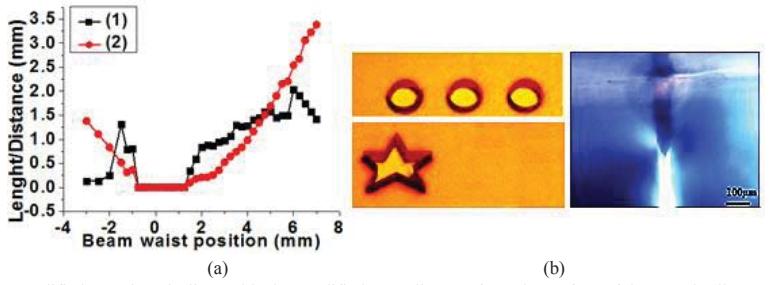
Through precise variation of water film thickness and beam waist position relative to the surface of the sample a selective filament formation position is achievable. Due to nonlinear losses of the filament, structural modification zones are formed in fused silica, which are more susceptible to chemical etching than unmodified zones (figure 1 (b-right)), the etching rate was calculated to be 0.44 μm/min in the modified zones. As shown in figure 1(a), depending on the focal position of the beam waist and the thickness of water, modified zones form in different lengths and at different positions relative to the surface. 2 mm wide and 0.5 mm deep through holes were fabricated after laser exposure time of 1 minute and 12h etching in 5% HF acid in fused silica. Surface ablation is observable in figure 1(a) in the overlapping red and black dot areas. Due to self-focusing effects and rapid evaporation of water, material removal rates tend to be substantially higher, 2 mm wide, 1 mm deep through holes were fabricated in soda-lime glass after 2 minutes of laser exposure time (figure 1 (b- left). Moreover, the possibility of complex shape fabrication has been demonstrated (figure 1 (b-left)). The pentagram is about 1.5 mm wide. Holes fabricated either method show no signs of cracks or conicity.