Mesenchymal stem cells (MSCs) are multipotent cells possessing transdifferentiation, self-renewal and immunomodulatory properties. It was noticed that MSCs preferentially migrate toward tumors due to chemokine signaling [1]. Because of their inherent tumor tropism, MSCs could be used as nanoparticle delivery vehicles [2]. Quantum dots (QDs) are fluorescent semiconductor nanoparticles. They have unique optical properties and can be easily modified with proteins, drugs, antibodies and other molecules for targeted drug delivery [3]. These characteristics enable QDs to be used as multifunctional anti-cancer nanoagents. However, knowledge about the influence of QDs on skin MSCs is still limited.
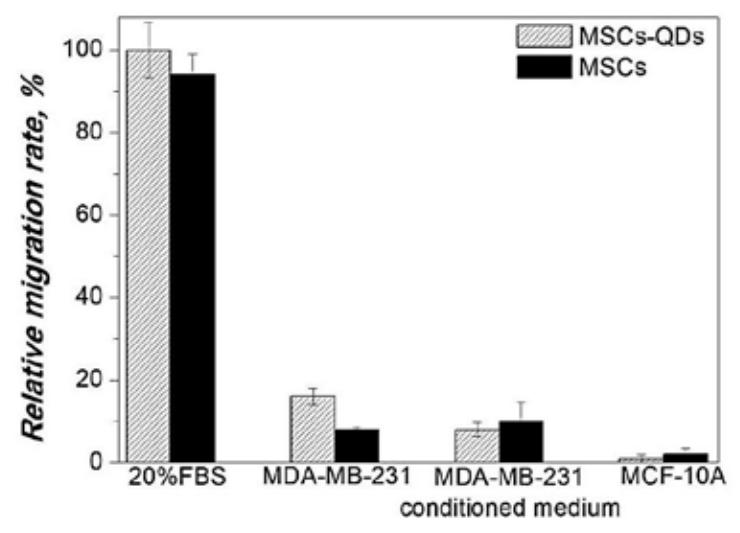
In this study, we investigated the effect of QDs on intrinsic properties of MSCs. We used human dermal MSCs and commercially available Invitrogen Qdot® 625 ITKTM Carboxyl QDs. Cell migration assay kit containing polycarbonate inserts with 8 μm pores was used to detect MSCs in vitro migration toward MDA-MB-231 breast cancer cells and MCF-10A mammary epithelial cells. CB17 SCID immunodeficient mice with human breast cancer xenografts were used to evaluate in vivo migration of MSCs. In vitro results showed that MSCs selectively migrate toward cancer cells and QDs do not reduce the migration of the cells (Fig. 1.). The experiments with immunodeficient mice revealed that MSCs localize in the sites of tumor and metastasis. While co-culturing QD-loaded MSCs and unlabeled cancer cells, we detected that the exchange of nanoparticles between the cells is minimal. It shows that MSCs could safely transport QDs through the body. Our results show promising potential of MSCs to be used as nanoparticle carriers to the tumors.