
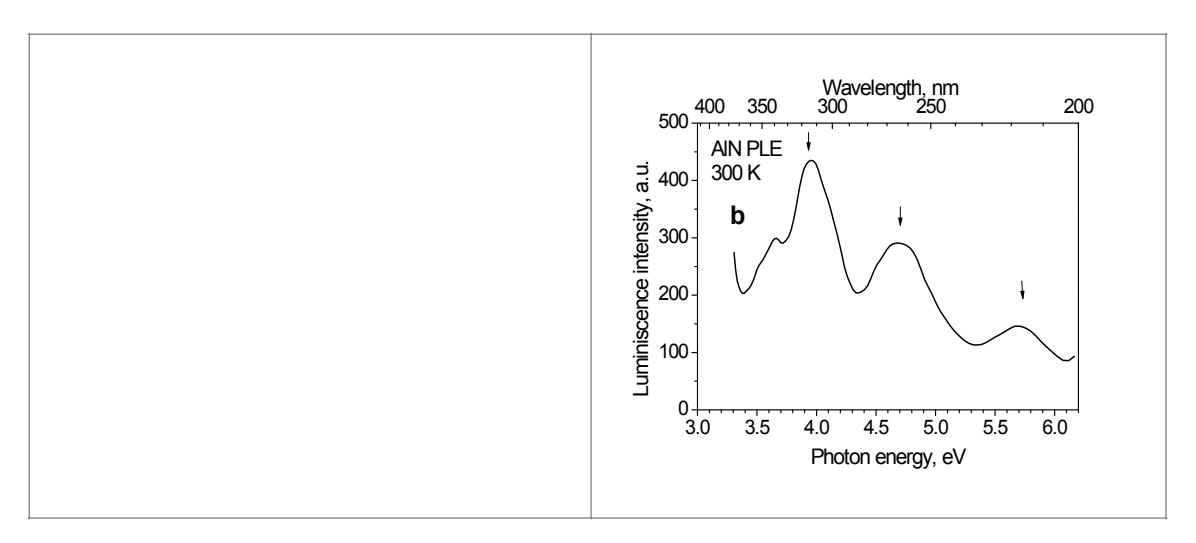
Oxygen gas sensing properties based on defect induced luminescence of AlN nanopowder were studied. Spectral characteristics of AlN nanopowder with 60 nm average grain size were examined. Photoluminescence (PL) spectra and its excitation spectra (PLE) measured at room temperature (RT) are depicted on Fig.1, a and b, correspondingly. It was observed that for AlN a wide luminescence band at 420 nm (blue luminescence - BL) is characteristic (Fig. 1, a), which can be excited either through exciton processes (215 nm) or by direct defect excitation with ultraviolet light forming two separated spectral bands at 260 nm and 315 nm (Fig. 1,b). This luminescence is distinct from those observed in AlN materials with bulk structure [1]. It was found, that the 420 nm luminescence is sensitive to oxygen gas surrounding the material, resulting in quenching of luminescence intensity as it is demonstrated on Fig. 1, a, where four PL spectra are depicted obtained under sample excitation with 265 nm light. The first and the second PL curves were measured when sample is surrounded with vacuum (~10-5mBa) or nitrogen gas. On contrary, the third and fourth PL curves, which were measured, when sample was put into dry air or pure oxygen gas, are with considerably reduced intensity demonstrating luminescence quenching.
From the results of spectral characterization of hBN material it follows, that the F-centers, formed from the nitrogen vacancies with trapped electrons, could be the possible defects responsible for the BL. In this case the defects, which are close to the material surface, are interacting with environmental oxygen gas.
BL characteristics demonstrating oxygen gas sensing properties of AlN materials were investigated. They are: i) gas sensing parameter of material measured as ratio of BL intensity when sample is in vacuum or in gas, ii) repeatability of measurements, iii) oxygen sensitivity graduation curve obtained at different oxygen gas concentrations in gas mixture.
The results obtained allow joining AlN nanopowder to the material class prospective for application as luminescent sensors of oxygen gas.