3D MICROFABRICATION OF GOLD NANOPARTICLE DOPED HYBRID POLYMER VIA FEMTOSECOND LASER PULSES
Linas Jonušauskas1, Marcus Lau2, Peter Gruber3, Bilal Gökce2, Stephan Barcikowski2, Mangirdas Malinauskas1, Aleksandr Ovsianikov3
1 Department of Quantum Electronics, Vilnius University, Saulėtekio Ave. 9, Vilnius LT-10222, Lithuania
2 University of Duisburg-Essen and Center for Nanointegration Duisburg-Essen (CENIDE), Technical Chemistry I, Universitaetsstr. 7, 45141 Essen, Germany
3 Institute of Materials Science and Technology (E308), TU-WIEN (Technische Universitt Wien), Getreidemarkt 9, 1060 Wien, Austria
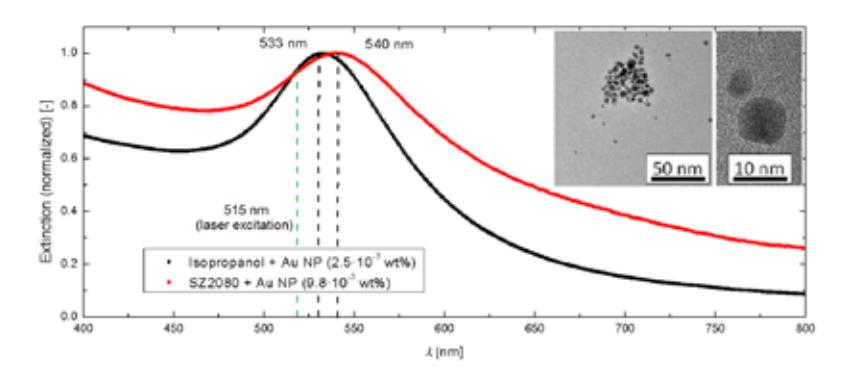
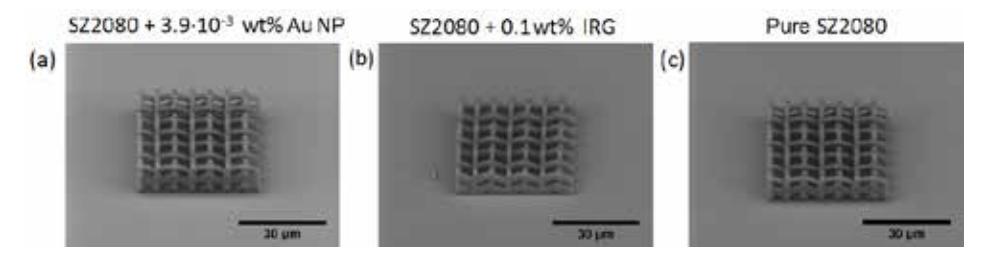
3D laser lithography (3DLL) [1] of a negative photopolymer (zirconium/silicon hybrid solgel SZ2080) doped with gold nanoparticles (Au NP) is performed employing a 515 nm, 200 kHz and 300 fs amplified laser system. The Au NP are generated via pulsed laser ablation in liquids (PLAL) [2] and sized around $\sim$7 nm [Fig. 1]. The effect of doping is explored - by varying the nanoparticle concentration from 4.8·10-6 wt% to 9.8·10-3 wt% we find that the fabricated line widths are both enlarged and diminished. The increase in feature size by up to 14.8% (when doped with 3.9·10-3 wt% Au NP) compared to structures achieved in pure SZ2080 is observed. While implicating both positive and negative effect on the photosensitivity, the doping has no adverse impact on the mechanical quality of intricate 3D microstructures produced from the nanocompound [Fig. 2]. Additionally, we found that SZ2080 increases the long term ($\sim$months) colloidal stability of Au NP in isopropanol.
Fig. 1. Normalised extinction spectra of Au NP in isopropanol (peak centered around 533 nm) and SZ2080 doped with Au NP (peak around 540 nm). Concentrations are 2.5·10-3 wt% and 9.8·10-3 wt%, respectively. Green dashed line - laser wavelength applied for excitation (515 nm). Insets show HR-TEM images of particles used in this work.
Fig. 2. Comparison of structures produced out of SZ2080 doped with 3.9·10-3 wt% Au NP (a), SZ2080 with 0.1 wt% IRG (b) and pure SZ2080 (c). Fabrication from the material combining polymer and Au NP shows no influence on the mechanical quality of the structure.
Explanation based on Au NP plasmonic properties granting discussed phenomena is given. This knowledge can be used as a base for future work aimed at further examining mechanisms in pulsed laser processing of nanoparticle doped polymers. Also functional devices owning exotic properties [3] granted by combination of 3D micro-architecture and Au NP can be realized by 3DLL and potentially applied in novel photonic devices and biomedical scaffolds to mention a few.
[1] M. Malinauskas, A. Žukauskas, S. Hasegawa, Y. Hayasaki, V. Mizeikis, R. Buividas and S. Juodkazis, Ultrafast laser processing of materials: from science to industry, Light: Sci. Appl., in press (2016).
[2] D. D. Zand, P. Nachev, R. Rosenfeld, P. Wagener, A. Pich, D. Klee and S. Barcikowski, Nanocomposite Fibre Fabrication via in situ Monomer Grafting and Bonding on Laser-generated Nanoparticles, J. Laser Micro. Nanoeng. 7(1), 21-27 (2012).
[3] S. Eustis and M. A. El-Sayed, Why gold nanoparticles are more precious than pretty gold: Noble metal surface plasmon resonance and its enhancement of the radiative and nonradiative properties of nanocrystals of different shapes, Chem. Soc. Rev. 35(3), 209-217 (2006).