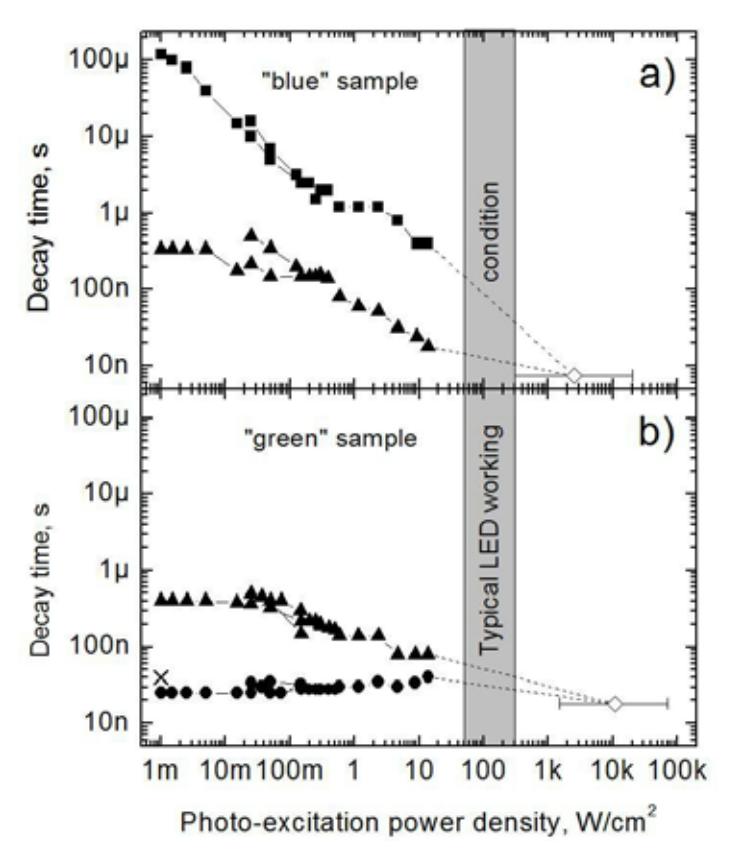
In this work we demonstrate the use of frequency domain lifetime measurement (FDLM) technique to measure the lifetime of light emitting diode (LED) samples. The samples were excited using harmonically modulated light, in the wide frequency range – from 1 Hz to 100 MHz, which enables the measurement of long and stretched decay dynamics giving deep insight into carrier recombination processes.
Using 405 nm resonant excitation enabled the excitation of carriers in quantum well region only, leaving cladding layers unaffected. In order to reveal origin of recombination and delocalization processes, experiments were carried out in a wide temperature (from 10 to 300 K) and excitation power density (from 0,001 to 15 W/cm2) range,. The samples, used in experiment, luminesce with peaking wavelengths at 450 and 530 nm and are referred as "blue" and "green" samples in the figure 1. The decay times were evaluated using Fast Fourier-transform (FFT) analysis. This study revealed three exponential decay channels, with components in sum-μs, μs and ns timescale range, for the "blue" sample while "green" can be characterized by two decay channels in sum-μs and ns timescale range.