
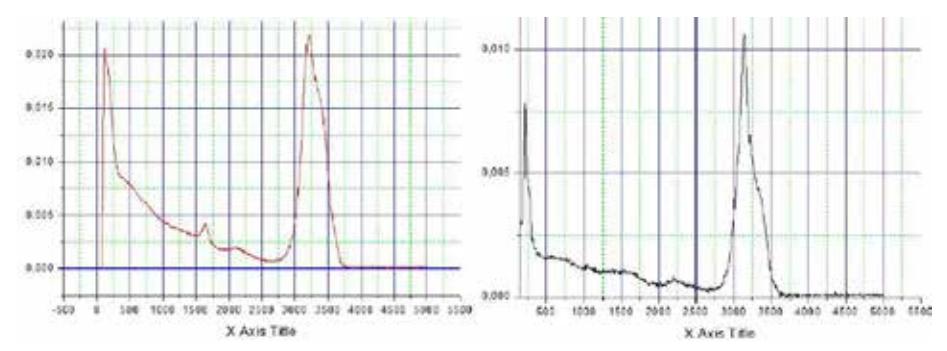
Water is an interesting and important object for spectroscopic investigations. The local structure of water is still under debate [1], and any alternative new way to estimate it is very useful. Having this in mind, extensive Raman studies of bulk water in different phases and temperatures were made. It was found that the relative Raman line intensities of bending H-O-H vibrations are very sensitive to the phase structure of water. In Fig.1 one can see strong changes of relative intensities of this band during going from the liquid to solid phase (Fig. 1).
To find the reason for these changes some quantum-chemical calculations were made. The structure of a pentamer water cluster was optimized under tetragonal conditions using B3LYP/cc-pVTZ level of theory.
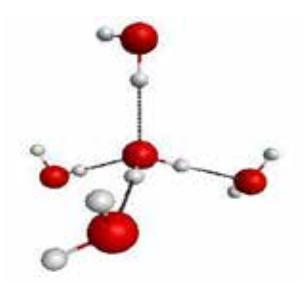
In this model (see Fig. 2) we have one (central) molecule with two acceptor and two donor H-bonds, two molecules with only one donor H-bond and two molecules with only one acceptor H-bond. The Raman spectrum for this cluster was calculated. As one can expect the frequency of the bending vibration of water molecule increases when the number of donor H-bonds increases. For the Raman intensities of this mode the situation is different. The calculated intensity for this vibration is 10 times smaller in the case of double donor H-bonds and 5 times smaller in the case of single donor H-bond when comparing with molecules without donor H-bonds. Now we can analyze how the observed spectral changes are associated with the local structure of water. According to [2] liquid water is a mixture of HDL and LDL with 3:1 proportion. LDL has similar to ice at ambient condition a local structure where every water molecule has double acceptor and donor H-bonds. HDL has broken tetragonal structure where the water molecules on average have only one donor H-bond. So it is clear that the appearance of the 1630 cm-1 line in liquid water is mostly due to HDL. On the other hand, the near-absence of this line in solid water (in ice) is due to the fact that only molecules with double donor H-bonds are in this case. We hope that this approach can be developed for estimation of the LDL/HDL ratio at different temperatures and pressures.