
Biofunctional patterning technologies such as dip-pen nanolithography or micro-contact printing are used for patterning of selectively graft proteins, peptides and other biomolecules on solid supports, which are mostly used in the biomedical field. However, patterning of biomolecules efficiently without losing their functionality and structure is a difficult task. Furthermore, it gets more challenging if multi-biomolecular patterns, which are more preferred for biomedical applications, are needed to be produced.
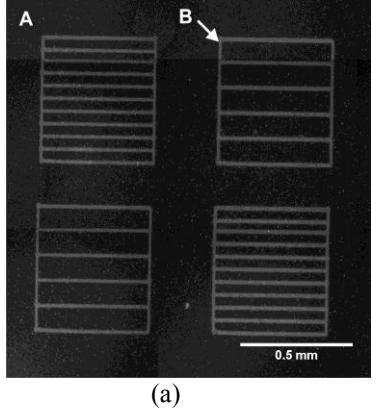
This work represents the technology of self-assembly monolayer (SAM) pattern production which is based on direct laser writing (DLW) technology. Firstly SAM matrix is grown on the gold surface; then nanosecond laser pulses are used to interrupt the bond between the SAM molecule and the gold coating, which is deposited on silicon sample. The laser irradiation creates a selective surface for another type of SAM to be grafted thus forming a new pattern of multiples types of SAM (Fig. 1). Newly created patterns can be joined with proteins and other biomolecules for biochip production.
This technology is very advantageous for forming multi-biomolecular patterns [1,2]. It reduces the cost and time of pattern production, as it does not require costly mask development and provides an easy way of the pattern architecture adjustment. Also, due the usage of the high-speed beam scanning equipment, this technique provides fast and accurate (in micrometric scale) patterning.