
Terahertz (THz) radiation represents the region in the electromagnetic spectrum between far-infrared and microwave radiation and has frequency between 0.1 THz and 10 THz (wavelength varies from 3 mm to 0.03 mm). The radiation in this region of electromagnetic spectrum is non-ionizing and safe. Moreover, it can easily pass through clothing, wood, paper, various plastics and ceramics. Furthermore, vibrational and rotational transitions of various molecules have energies in THz frequency range. This leads to a wide range of applications, such as spectroscopy, biological and medical imaging, detection of hazardous materials, security screening, etc. For over a decade, scientists and engineers have been investigating this radiation and developing new THz sources and detectors.
In our experiments THz radiation was generated in ambient air by focusing three different wavelength laser pulses. As a pump source the Ti:Sapphire laser system (central wavelength about 790 nm) operating at 1 kHz and delivering 9 mJ pulses of 35 fs (FWHM) duration was used. The pump beam was divided into two beams by using a beam splitter. One beam was used to pump Optical Parametric Amplifier (OPA), which generated tunable in wavelength signal (1140-1600 nm) and idler (1600-2600 nm) waves. These two waves were aligned collinearly with the second laser beam and focused into air. Due to strong nonlinear interaction between these three pulses, THz radiation was effectively produced in the laser-generated air plasma.
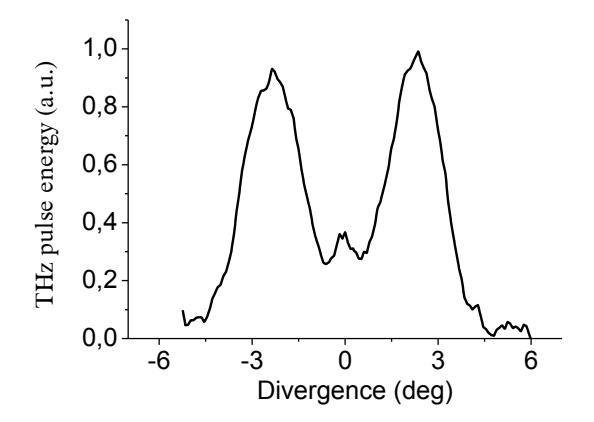
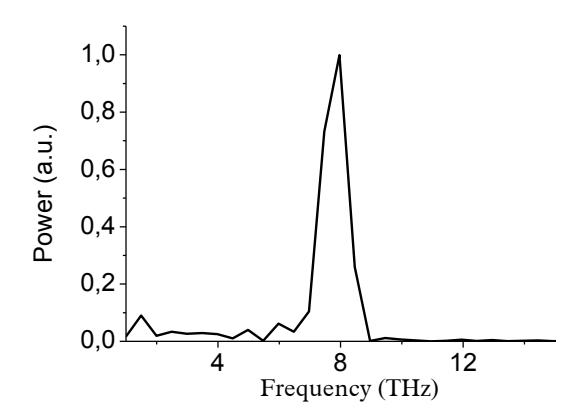
The results of the research show that THz radiation spatial profile (Fig. 1.) has typical conical shape with divergence of about 5 degrees. The spectrum of generated THz beam was measured using Michelson interferometer. As shown in the graph above (Fig. 2.), THz spectrum obtained using a sapphire beam splitter is from 0.1 to 9 THz with a maximum at 8 THz. Note that using a nitrocellulose pellicle beam splitter resulted in THz spectrum of up to 115 THz with maximum at 30 THz. In conclusion, spatial and spectral characteristics of THz radiation, generated by three femtosecond laser pulses of different wavelengths focused in the air, have been investigated. The obtained results indicate that a broadband THz emission can be generated using this method.