
Bessel beams belongs to a class of nondiffracting beams which transverse intensity profile does not change in free space propagation. Nondiffracting beams were found as a solution to the scalar Helmholtz wave equation in cylindrical coordinates [1] and for the first time experimentally showed by Durnin in 1987 [2]. Beam solutions to the scalar wave equation do not represent the polarization state of beam. Also, in a paraxial approximation electric field has nonzero divergence and therefore does not satisfy Maxwell's equations in the exact sense [3]. Contrary to scalar beams, vector beams exactly fulfill Maxwell's equations and can be formed with various polarizations (radial, azimuthal, circular or linear).
In our work vector Bessel beam solution was found using method described by Stratton [1]. By using the scalar Bessel beam function $\psi$, three vectorial fields L, M, N were obtained with the following definitions: L = $\nabla\psi$, M = $\mathbf{L} \times \mathbf{a}$, N = $-\frac{1}{k}\nabla \times \mathbf{M}$
where k – wavenumber of the beam, a – arbitrary vector. Vectors M and N represent fields E and H respectively. In our case arbitrary vector is a = (x,y,z). This novel type of vector Bessel beam has a spherical 3D doughnut placed in its distinct focal line (fig. 1). In this work, we also analyze how the curvature of produced 3D doughnut can be controlled and discuss the far field structure of such vector beams.
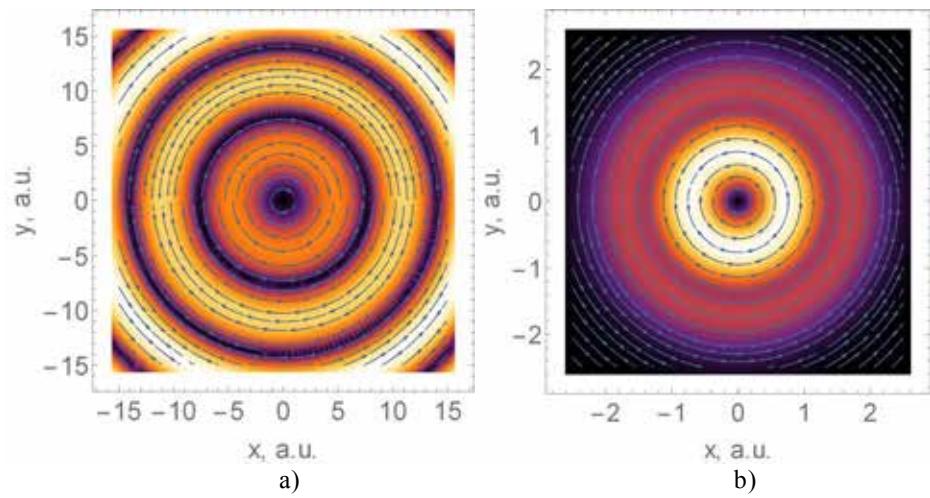
This type of vector Bessel beam as well as vector Bessel-Gauss beam has dark focus in the center of beam surrounded by region with higher intensity. However, vector Bessel beam has infinite number of intensity rings and has infinite energy thus can not be experimentally realized. Intensity profile in fig. 1 (b) has the structure of so called optical bottle beam, which has potential application in guiding and binding of micro-particles [4] and in optical tweezers system [5].