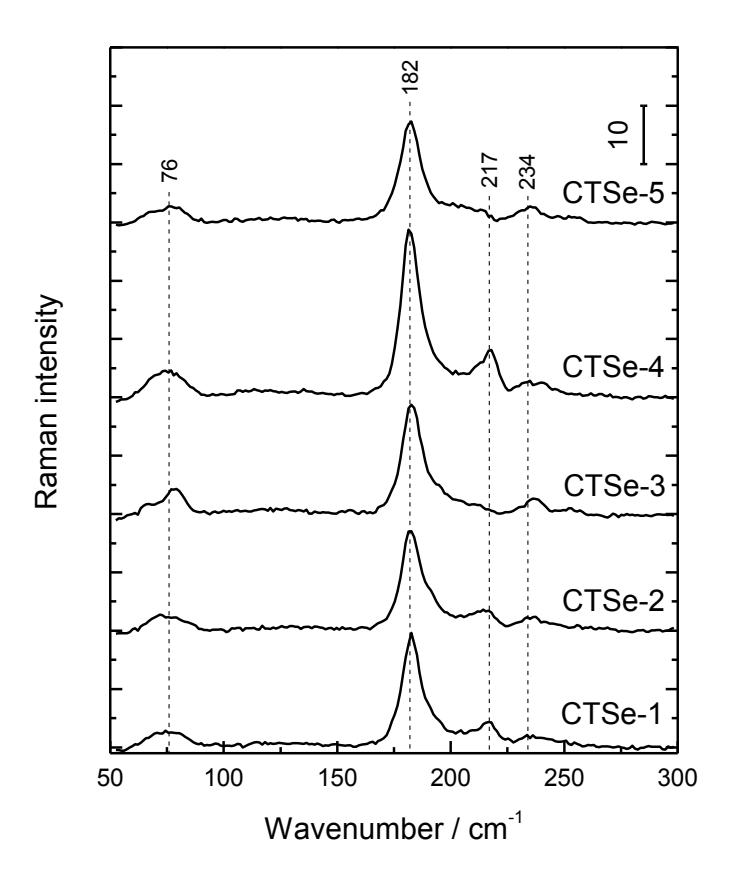
Thin film Cu2ZnSnSe4 (CZTSe) absorber for solar cells is a promising alloy to boost a progress in photovoltaic (PV) materials industry. Kesterites as CZTSe contain chemical elements that are easy and cheap to obtain from Earth's crust. Researchers have found that CZTSe optoelectronic properties are strongly dependent on the structural properties, crystalline quality and presence of secondary phases in the absorber layer [1]. In order to recognize spectroscopically secondary phases we have made five different CTSe (Cu2SnSe3) precursors by using different amount of selenium, annealing temperature and annealing time, as properties of kesterites are dependent on their precursors properties. CTSe photovoltaic derivatives were probed by Raman spectroscopy with 633 nm excitation wavelength (Fig. 1).
The dominant feature near 182 cm-1 and broad band at 76 cm-1 belongs to A' mode of CTSe. Comparing Raman spectra we observed that CTSe-3 sample demonstrates intense Raman band at 236 cm-1 wavelength, which is assigned to v(Se-Se) and belongs to trigonal Se (t-Se) [2]. Raman band characterized at 216 cm-1 is not observed at CTSe-3 Raman spectra. This indicates that Raman spectroscopy is able to probe subtle structural changes of CTSe dependent on annealing time and temperature.