
Nowadays, the technology of organic light emitting devices undergoes a breakthrough due to introduction of novel emission mechanisms adopting delayed florescence generated by triplet-triplet annihilation (TTA) [1] or thermal activation (TADF) [2]. In this work, the ability to control the characteristics of photoluminescence of donor-acceptor pyrrole pyrimidine derivatives with intramolecular charge transfer features are investigated as potential delayed fluorescence emitters.
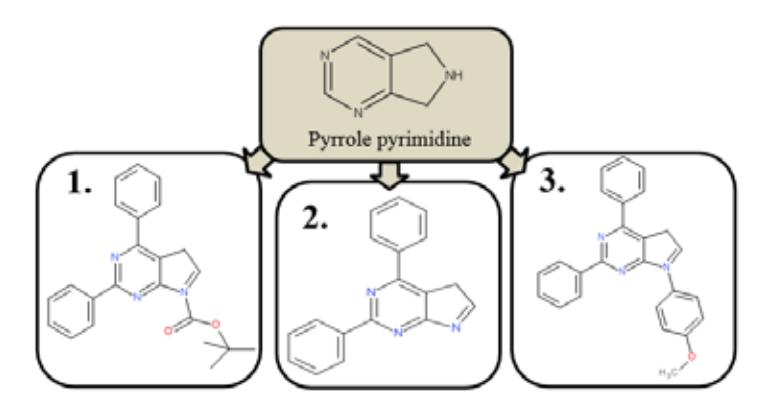
The pyrrole pyrimidine molecule is identified as an efficient blue emitter, exhibiting antitumor, antiviral and antibacterial attributes [3]. Here we analyze the optical characteristics of three pyrrole pyrimidine derivatives with acceptor-like (1), donor-like (3) substituents and without a substituent (2) at pyrrole nitrogen atom position.
The analysis of emission in an extensive time range reveals three radiative relaxation pathways intrinsic to all of the pyrrole pyrimidine derivatives: fluorescence of charge transfer states, delayed emission of molecular aggregates and molecular phosphorescence. Studies of spectral and transient properties of fluorescence lead to conclusion that intramolecular charge transfer character is enhanced by increasing polarity of the substituent. It is evident by the decrease of the oscillator strength (by factor 2.4), increase in relaxation decay times (from 0.38 ns to 10.56 ns) and bathochromic shift (from 3.2 eV to 2.79 eV) registered from the most acceptor-like compound to the most donor-like compound. The photoluminescence properties measured in 15 K temperature reveals the independence of triplet energy state (positioned at 2.455 eV) from polarity of the substituent, due to excitation localization on the pyrrole pyrimidine core.
The constant intensity of photoluminescence in extensive temperature range (15 K – 300 K) displayed by 3 derivative leads to an absence of thermally activated delayed fluorescence process. Meanwhile, a decrease in intensity is demonstrated by 1 derivative. It is assumed that energy relaxation pathway is not prevailed by thermal activation also and dominated by non-radiative mechanisms, unrelated to triplet energy state. This argument is supported by the wide singlet-triplet energy state gap ($\Delta E$ varying in range of 0.705 eV - 0.52 eV). The quadratic dependence of the intensity of photoluminescence on excitation fluency implies presence of triplet-triplet annihilation process, although, the effect is non-dominant. Thus, the radiative properties of pyrrole pyrimidine derivatives are dominated by the intramolecular charge transfer character and its effect is enhanced by the increase of the polarity of the substituent.