
Hot exoplanets have been shown to orbit their host stars on highly circularized orbits. It is however not always so. Some planetary systems containing massive exoplanets on short orbits show curious eccentricities, suggesting external effects. With recent progress on exoplanetary research, this issue can be further looked into.
During this work planets whose orbits appeared eccentric were investigated, focusing on the possibility of their systems hosting additional objects on larger orbits. To this end, a sample of exoplanets was chosen along specific criteria, so as to make certain to filter out planets that do not fall into the 'hot exoplanet' definition. Thus, the objects had to be transiting ones – to make certain their orbits are short, their transit depth had to be greater than 10 mmag, which defined the size of the exoplanets. In addition, convenience criteria were chosen, such as that the host star's brightness had to be lesser than 13.5 magnitudes, and the objects declination greater than 0°. This was so that objects with none (or highly inaccurate) radial velocity measurements would be excluded, and that the resulting selection would be of use to the observatories on the northern hemisphere respectively.
Using radial velocity measurements of the host stars, as well as recorded moments of transit, orbits were fitted (Fig.1.) through the SYSTEMIC [1] software which calculated precise eccentricity factors. From these, a catalogue was prepared, containing 73 objects showing non-circularity in their orbits. .
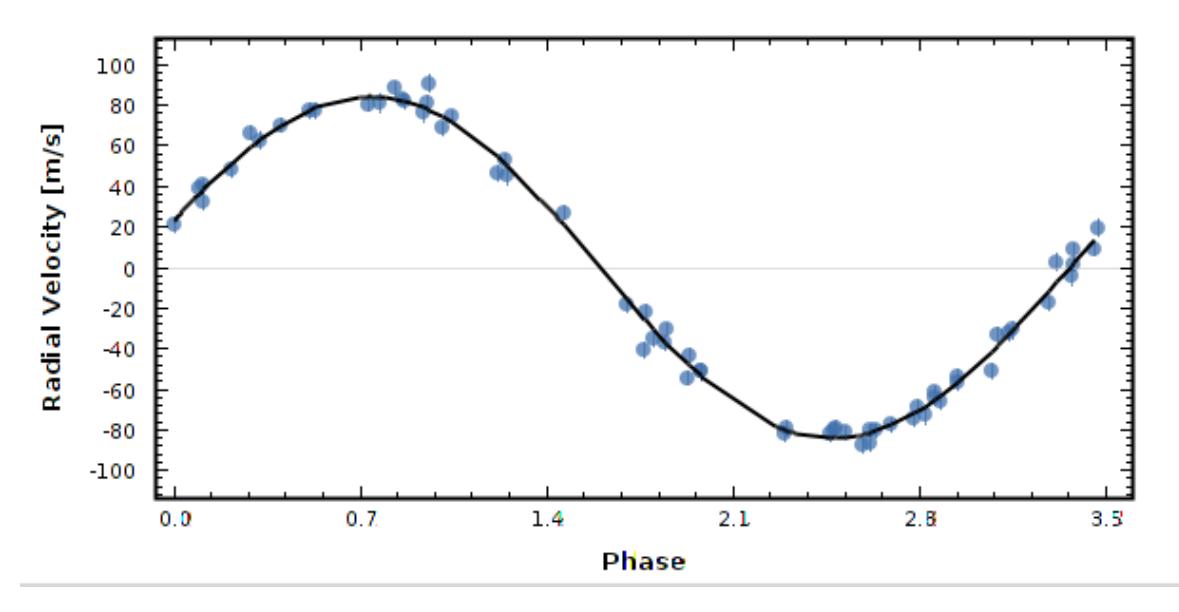
Following, a 'goodness' factor was determined as the relation of eccentricity to its uncertainty, whereas if the factor was higher than 3, it was considered that the system most likely hosts another – yet undetected object.
As a result, 24 objects with a goodness factor of over 2 were found, in 18 of which the factor exceeded 3, which in turn nearly guarantees presence of an accompanying object. This marks the selected 18 systems as good candidates for further observation with a high chance of exoplanetary discovery.