
Rapid production growth of solar cell and modules also increases a need in novel device characterization equipment. One of quality control stages in solar cell production is device testing under standardized irradiation conditions, provided by solar simulators. The most commonly used irradiance and spectral distributions aim to match so-called AM1.5G conditions [1]. IEC 60904-9 Ed.2.0 [2] standard defines criteria of how A, B or C class can be assigned to solar simulator in three categories: spectral distribution match, temporal stability, irradiance distribution uniformity. Traditionally, Xenon arc lamps were the mostly used light source of solar simulators. However, they suffer from issues related to a relatively short lamp life and stability. Therefore, development of simulators based on light-emitting diodes (LEDs), such as one reported in [3], are getting more and more attention due to stability and long-time performance of light sources.
In this work, simulation results of irradiance and spectrum distributions for large (> 1 m2) solar simulators employing arrays of light-emitting diodes are presented. Also, photoresponse peculiarities for GaInP/GaAs/GaInAsP/GaInAs and perovskite/Si tandem solar cells were investigated. First of all, irradiance distribution models for all given LEDs were created and ratios between model's arbitrary units and real irradiance were determined by comparing computed values with corresponding experimental data. After computing irradiance distributions in case of 0.5 – 1 m distances between light-emitting diodes and measurement plain, arrays of each LED with AAA class irradiance uniformity were designed. Afterwards, distributions of spectra were computed for the plane of interest. Results of simulations are presented in Fig. 1. Obtained intensity distribution is presented in a left panel of the figure (Fig. 1a). Here one can clearly see that more than 1 × 1 m2 area would be uniformly illuminated at 1000 W/m2 irradiance within A-class requirements (within $\pm 2\%$). On the right panel of the figure (Fig. 1a) the resulting spectrum in one of the points of the sample plane is presented.
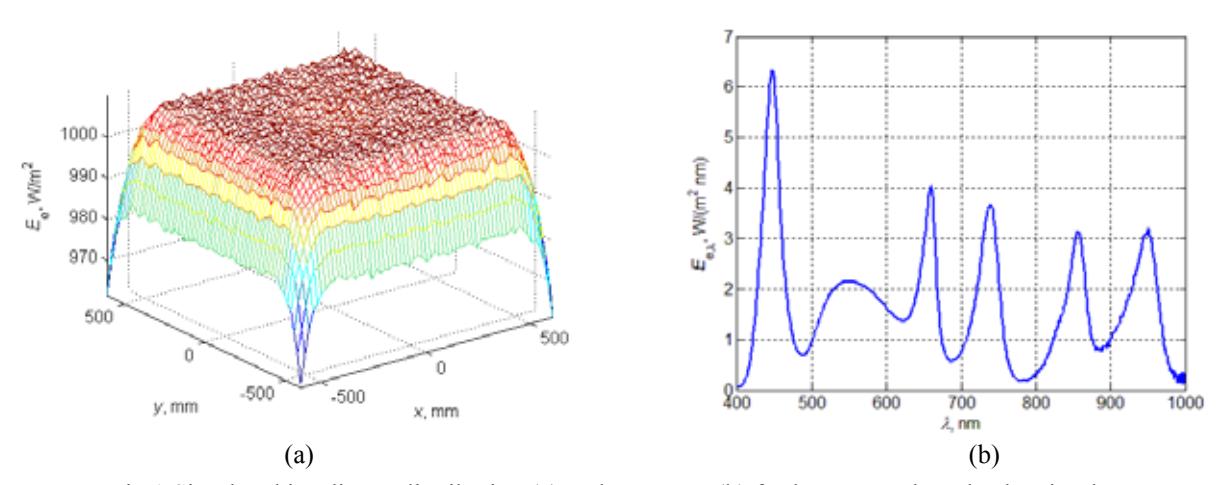
It has been established that 2486 LEDs are needed to build such solar simulator, in order for deviations from mean values of irradiance and photoresponse distributions to be small enough to fulfill all three A-class criteria as defined by AM1.5G standard. However it was determined, that type of simulator would still not be suitable for one of the most demanding applications - GaInP/GaAs/GaInAsP/GaInAs tandem solar cell examination due to the lack of infrared radiation with wavelengths above 1 μm. However, perovskite/Si cell should absorb all spectra effectively while generating photocurrent which should be similar for both active layers - approximately 27 mA/cm2.