
Surface Enhanced Raman spectroscopy (SERS) offers efficient techniques for material science. In recent years, a new application of SERS for cultural heritage and art pigment studies was developed [1]. Due to the possibility to get information about chemical structure of the objects under investigation, SERS is a powerful tool for pigments and dyes identification and hence for dating definition in authenticating of artworks. Moreover, the identification of art components is particularly helpful for conservators who can use the information for national treasures preserve.
SERS techniques are widely used for organic dyes identification. Recently SERS have been successfully applied for inorganic pigment identification in the real objects of cultural heritage [2]. Paints represent themselves the multiphase system of binding media and pigment microcrystals. The following sample preparation technique was proposed early [2] to provide close interaction between pigment microcrystals and gold nanoparticles: to extract pigments from the binding media via washing of paints in alcohol and chloroform under the slight heating. To avoid this stage of sample preparation, organic sol of gold nanoparticles was proposed to use in the present study due to its ability to dissolve the binding media.
For the SERS-analysis we used the organic sol of gold nanoparticles in toluene which has been prepared via Brust-Shiffrin method [3]. Optical density spectrum of the obtained Au-sol is characterized with the maximum on 525 nm. The microfragments of paints (not more than 1 μg) safety taken from the canvas painting "Portrait of young man" was used in the experiment as the analyte.
SERS-spectrum obtained in 100-950 cm-1 spectral range (Figure 1) is characterized with the high signal-to-noise ratio, while the Raman spectrum in the absence of gold nanoparticles have not been recorded at all. The peaks at 223, 289, 406, 491, 603, 654 cm-1 could be ascribed to ochre (Fe2O3+clay minerals).
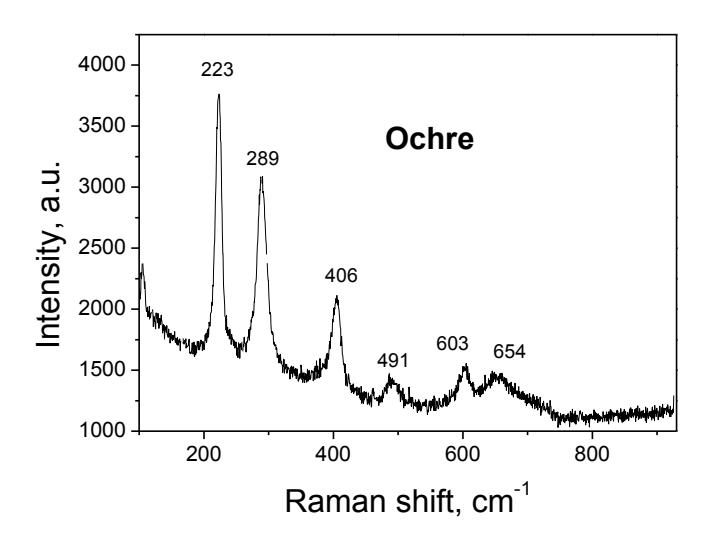
So, gold organic sol allows to simplify the sample preparation procedure for the SERS-identification of the art pigments in the Cultural heritage objects. The authors are grateful to Dr. E. Shabunya-Klyachkovskaya and Dr. O. Kulakovich for fruitful discussion as well as The National Art Museum of the Republic of Belarus for sample provided.