
Fused filament fabrication (FFF also known as fused deposition modeling or FDM) allows rapid and accurate materialization of computer aided design (CAD) models into real objects out of biodegradable polylactic acid (PLA). This technology is simple, cheap and flexible, thus can be implemented in a wide range of applications: from rapid sculpting of new product prototypes or custom counterparts to printing of microstructured objects owning internal architecture. The later one is particularly promising for cell culturing research and tissue engineering practice.
Three-dimensional porous micro-woodpile geometry structures can be successfully applied as templates for cell proliferation [1] and further be used as implants for tissue engineering (TE) as well as regenerative medicine applications. TE develops biological substitutes that restore, maintain or improve tissue function or a whole organ [2]. The aim of our research was production of various porosity microstructures for restoration of hard tissue (bone) by employing commercially available low-cost 3D printer and a standard material. It is known, that the pore size usually has to be within the range of 0.1-1 mm to be suitable for osteoblast cell growth. To manufacture such objects we used a widespread 3D printer (3DP) “Ultimaker Original“. This device empowers fabrication of free-form shapes out of thermoplastic using FFF technology. Our chosen thermoplastic was biocompatible, biodegradable, optically transparent PLA. Also we applied colored (for additional functionality) and photosensitive PLA (highly luminescent under UV light).
Cell growth in the 3D woodpile depends on its microstructure and porosity, for this reason we decided to continue ours researches with woodpiles having hexagonal inner geometry representing the most balanced architecture in both mechanical and pore spatial distribution perspectives, respectively. To compare hexa-woodpiles with simple and shifted geometry woodpiles, hexa-structure ensures the strongest mechanical properties and characterization [3]. Further, the 5.5 mm diameter circles were subtracted from the manufactured woodpile using laser light filamentation (LLF) in water technology [4]. Their SEM images are described in Fig. 1. Samples of subtracted circles were given for researches from Vilnius University Institute of Biochemistry. The micro-scaffolds were placed into the created standardized defect in rat's skull. 60 days later animals were euthanized and implants were taken for histology analysis. Results of histology show incomplete callus formation. However, a layer of bone was seen surrounding the whole grafted segment and the center of the defect was filled with connective tissue. Micro-scaffolds were partially resorbed as well as there were no inflammatory reactions observed.
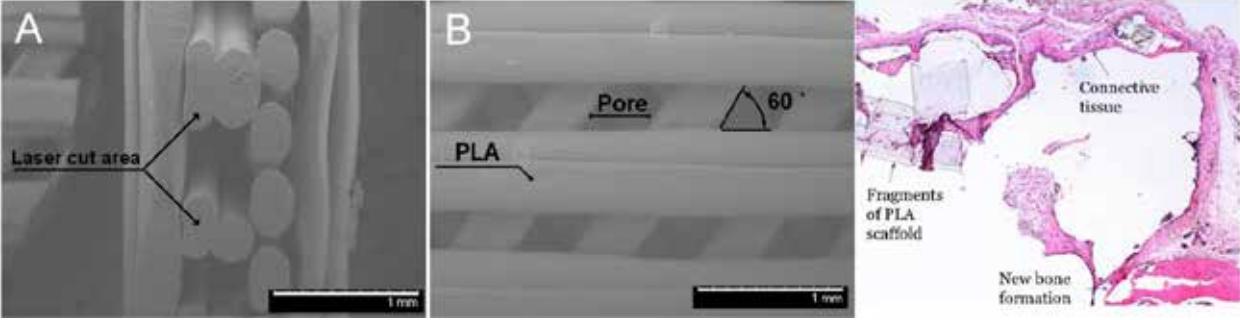
In brief, our proposed approach employing tabletop 3D printer of “hobby" level enables creation of personal microfabrication laboratory at home offering production of custom made 3D structured templates of biocompatible as well as biodegradable PLA thermoplastic material. In comparison to material subtraction (milling) or lithography techniques – FFF additive manufacturing provides possibility of straightforward 100% material usage.